Fear of labour pain is one of the most common worries women bring into pregnancy, and one of the least discussed, because “normal delivery” has quietly been turned into a test of endurance. It is not. Asking for pain relief is a medical choice, not a personal failing, and modern maternity care can offer it in most hospital births.
At Blossom Women Wellness Clinic in Vaishali Nagar, Jaipur, Dr. Sunita Choudhary, an experienced FOGSI-member female gynecologist and obstetrician with 15+ years of practice, and Senior Consultant at Shalby Multi-Speciality Hospital, Jaipur, discusses delivery planning, epidural options and what to expect from labour honestly, in Hindi or English, so you can decide before the big day.
This article provides general health information. For personalised delivery planning in Jaipur, book a consultation on +91 9928070006.
Painless Delivery Meaning (in Hindi & English)
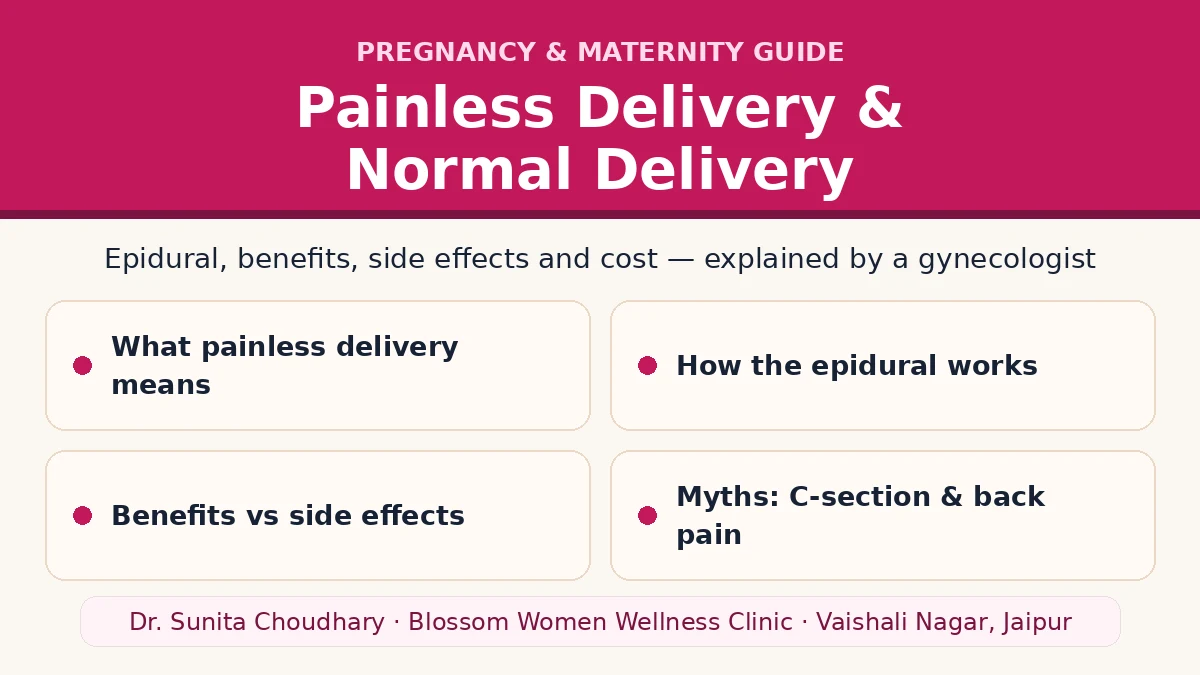
“Painless delivery” is not a separate medical procedure, it is everyday language for childbirth with effective labour pain relief, most commonly an epidural. Doctors call this labour analgesia.
In Hindi: painless delivery का मतलब है दर्द रहित या लगभग दर्द रहित प्रसव, यानी प्रसव के दर्द को दवा से कम करना, ज़्यादातर एपिड्यूरल (epidural) के ज़रिए। (Painless delivery kya hoti hai? Matlab: delivery ke dauraan dard ko epidural jaisi dawa se kaam karna, jabki aap hosh mein rehti hain.)
Two terms are worth knowing:
- Analgesia = pain relief while you stay awake and aware. An epidural during labour is analgesia.
- Anaesthesia = loss of sensation, used for surgery. A C-section is done under anaesthesia.
So the word “painless” in painless delivery refers to pain relief during labour, it has nothing to do with whether the baby is born vaginally or by operation.
Normal Delivery vs Painless Delivery: They Are Not Opposites
Many women think they must choose between a “normal delivery” and a “painless delivery”. In reality these describe two different things:
| Term | What it describes |
|---|---|
| Normal (vaginal) delivery | The route of birth, the baby is born through the birth canal |
| Painless delivery | Pain relief during labour, most commonly an epidural |
| Epidural | Medicines given through a small tube in the lower back that reduce labour pain while you remain awake |
| C-section | A surgical route of birth, performed under anaesthesia |
A painless normal delivery, vaginal birth with an epidural, is therefore exactly what it sounds like: your preferred route of birth, with the pain made bearable. Choosing pain relief does not push you towards a C-section, and declining it does not earn a medal. There is no need to prove that you can tolerate labour without help.
Is Painless Normal Delivery Possible?
Yes, for most hospital births there is no medical reason why pain relief and a vaginal birth cannot go together. Epidural analgesia is one of the most widely used procedures in modern maternity care.
But “painless” is honest language for greatly reduced pain, not the absence of all sensation:
- An epidural usually removes most of the sharp pain of contractions, while pressure often remains.
- Relief can be incomplete or stronger on one side; the dose may need adjustment.
- Placement and onset take time, so it cannot always be arranged at the last minute of labour.
- It requires a hospital with an anaesthesia team and monitoring, it is not a home-birth option.
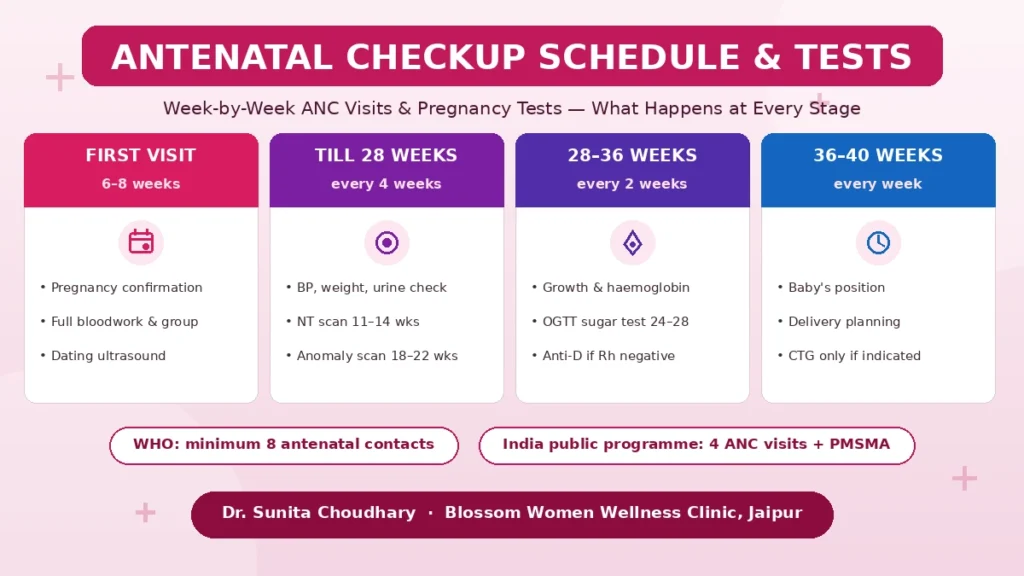
This is exactly why the conversation belongs in your antenatal visits, not in the labour room. Our antenatal checkup schedule and tests guide shows where delivery planning fits week by week.
How the Epidural Works, Step by Step
- Assessment and consent. The anaesthetist reviews your history, allergies, reports and labour progress, and explains benefits, risks and alternatives.
- Placement. After numbing the skin, a thin catheter is placed in the lower back; the needle is removed and only the soft tube stays. You usually remain awake.
- Onset and adjustment. Medicines flow through the catheter; the team adjusts the dose and checks the level of relief, your blood pressure and the baby’s heartbeat.
- Monitored labour continues. You rest while the maternity team follows your comfort and the baby’s progress, guiding pushing when the time comes.
Tell the team if pain returns or is felt more on one side, adjusting relief is routine, not a complaint.
Benefits of Painless Delivery
- Meaningful relief from contraction pain while you remain awake and involved in the birth.
- Rest during a long labour, exhaustion itself can complicate progress, and relief lets you save energy for pushing.
- A calmer experience for women whose fear of labour pain is intense or rooted in a previous difficult birth.
- A planned option in some medical situations where the doctor advises avoiding the full strain of labour pain.
- Clarity, relief can make it easier to think, ask questions and participate in decisions during labour.
Epidural Side Effects and Risks
Every pain-relief method has trade-offs, and the anaesthesia team will discuss them during consent. In brief:
| How common | What can happen |
|---|---|
| Common | Low blood pressure, itching, heavy or numb legs, difficulty passing urine, incomplete or one-sided relief needing adjustment |
| Less common | A severe headache after an accidental puncture of the spinal fluid cover; the pushing stage being affected |
| Rare | Serious infection, bleeding-related problems, or nerve injury |
Your blood pressure and the baby’s heartbeat are monitored while the epidural is working, and a fall in blood pressure can be treated promptly. An epidural does not promise a particular birth outcome, ask how it may affect movement, pushing and monitoring in your specific hospital.
Epidural Myths and Facts
| Myth | Fact |
|---|---|
| “An epidural always ends in a C-section” | No. An epidural does not make a caesarean necessary or inevitable; labour duration varies and the team guides the pushing stage. |
| “It causes permanent back pain” | The puncture site can be sore for a few days, but permanent back pain has not been shown to result from epidurals. |
| “Painless delivery means zero pain for every woman” | Relief is usually substantial but varies; pressure or some discomfort can remain, and doses may need adjustment. |
| “You can ask for it at the last minute and it works instantly” | Placement and onset take time, and availability depends on the hospital team, request it early. |
Who Can, and Cannot, Get an Epidural?
Suitability is decided jointly by the maternity and anaesthesia teams, not by a website or a promise. Tell the team about:
- Medical conditions, allergies and previous anaesthetic problems.
- Any medicines, especially blood-thinning treatment.
- Your previous birth experiences and what made them difficult.
A high-risk pregnancy, twins, a previous C-section, blood pressure or sugar problems, or other complications, needs individual planning rather than a blanket promise of eligibility. What “high-risk” really involves is explained in our high-risk pregnancy guide. If you had a previous caesarean and hope for a vaginal birth (VBAC), pain relief can usually be considered, but the scar itself needs separate counselling in a hospital equipped to monitor it.
Painless Delivery Cost in Jaipur
No honest fixed price can be printed here, because the total depends on the hospital, the room category, how the labour proceeds, and whether the birth remains vaginal. When you ask for an estimate, request it itemised, covering:
- Obstetric care and hospital stay.
- The anaesthetist’s fee and the epidural charges.
- Medicines, investigations and newborn care.
- What happens to the estimate if an assisted birth or C-section becomes necessary.
If you use insurance, check maternity waiting periods, sub-limits, exclusions and whether epidural charges are included, before admission, not after. The clinic can confirm its current consultation charges when you request an appointment.
When to Contact the Maternity Team
Pain-relief planning never overrides urgent symptoms. Contact your maternity unit the same day, or seek emergency care, if you have:
- Vaginal bleeding, or your waters breaking.
- The baby moving less than usual after 28 weeks.
- Painful contractions before 37 weeks.
- Severe headache with blurred vision, or swelling of the face and hands.
For severe symptoms, collapse, or an imminent birth, go to the nearest emergency department. A clinic WhatsApp reply is not an emergency service.
Guidance Referenced
- NHS, Pain relief in labour: nhs.uk/pregnancy/labour-and-birth/pain-relief-in-labour
- American Society of Anesthesiologists, Epidural steroid injections & epidurals explained: madeforthismoment.asahq.org/pain-management/epidural
- NHS, Epidural side effects: nhs.uk/tests-and-treatments/epidural/side-effects
- RCOG, Birth options after previous caesarean birth: rcog.org.uk
Individual pain-relief options always follow your doctor’s assessment of your specific pregnancy and hospital facilities.
Delivery Planning in Vaishali Nagar, Jaipur
Searching for the best gynae in Jaipur, a female gynecologist for delivery, or a maternity hospital near you in Vaishali Nagar or West Jaipur? Discuss normal delivery, epidural options and hospital birth planning with Dr. Sunita Choudhary at Blossom Women Wellness Clinic, Vaishali Nagar, the full offering is described on our normal delivery and painless delivery service page.
- Address: Gate 4, 10A, Shiv Path, near SDC Aishwarya Heights, Nand Vihar Colony, Nemi Nagar Extension, Block A, Vaishali Nagar, Jaipur 302021
- Call / WhatsApp: +91 9928070006
- Consultations Available In: English and Hindi
This article provides general medical information only and does not constitute a formal diagnosis or personalised treatment plan. For individual medical advice, please schedule a consultation.
— Dr. Sunita Choudhary
MBBS, MS (Obstetrics & Gynaecology), FOGSI Member
Senior Consultant Gynecologist & Obstetrician
Blossom Women Wellness Clinic, Vaishali Nagar | Shalby Multi-Speciality Hospital, Jaipur
This article is general health education, not personalised medical advice. For guidance specific to your case, book a consultation on +91 99280 70006 or message on WhatsApp.