How to Use a Pregnancy Test Kit
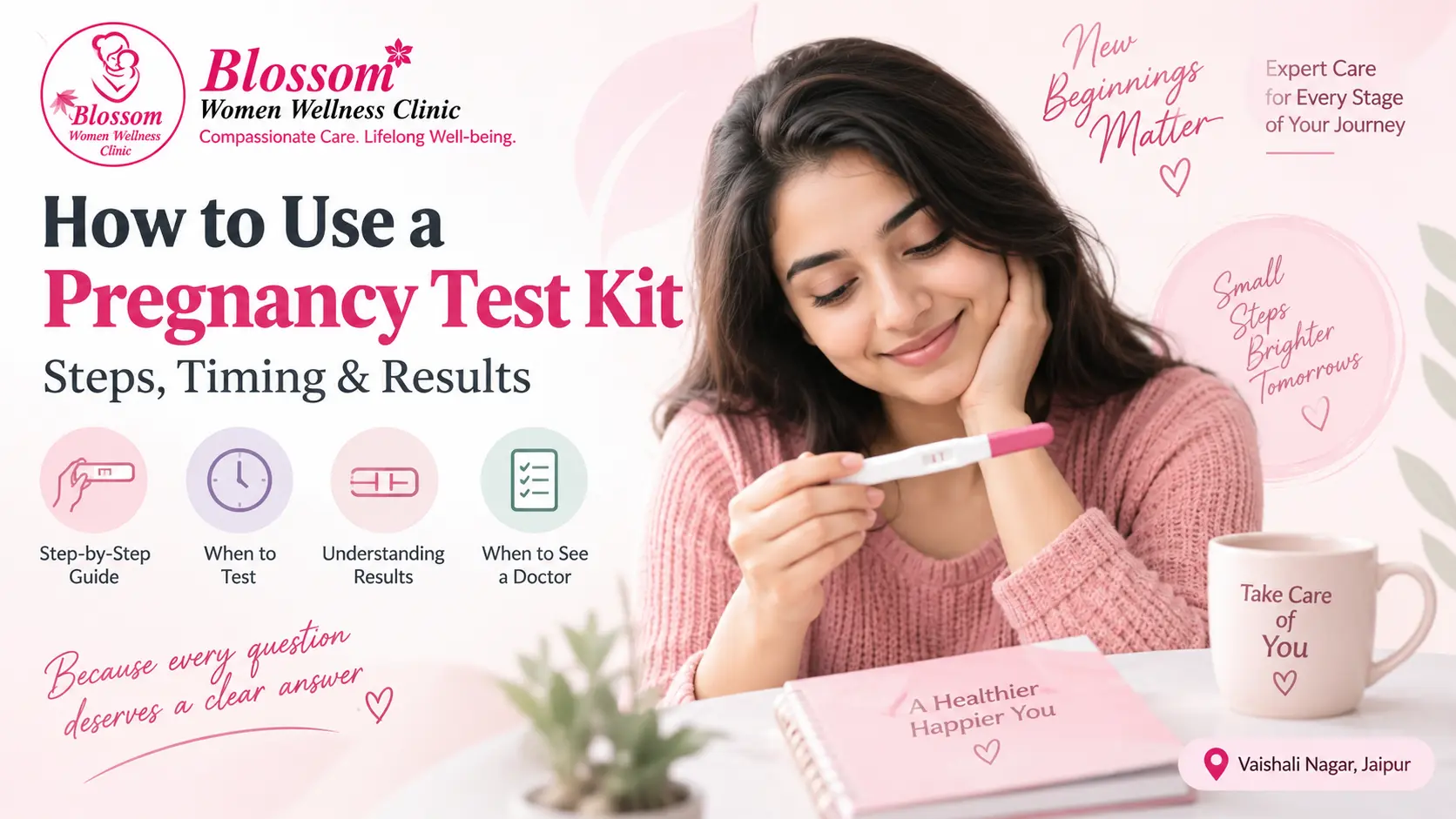
If you’re staring at a pregnancy test kit and wondering whether you’ve used it correctly, you’re not alone. Many people worry about testing too early, whether a faint line counts, or if they should test again. The good news is that most home pregnancy tests are very reliable when used at the right time. Knowing how to use a pregnancy test kit correctly helps you get the most dependable result and removes a lot of unnecessary anxiety.
Home pregnancy tests work by looking for a hormone called hCG (human chorionic gonadotropin). Your body starts producing this hormone after a fertilised egg attaches to the uterus, and it rises quickly in early pregnancy, which is why timing matters. According to guidance from the American College of Obstetricians and Gynecologists (ACOG), home pregnancy tests are highly accurate when used correctly after a missed period, and medical advice should be sought if results are unclear or symptoms continue.
At Blossom Women Wellness Clinic in Jaipur, we see these worries every week. One of the most common questions Dr. Sunita Choudhary hears in clinic is, “I got a faint line. Am I pregnant?” In many cases, the answer is simply that the test was taken very early. Evidence-based guidance, personalised care, and enough time to answer your questions are central to how we look after every stage of pregnancy.
This is general information, not a medical opinion for your specific case. For a personalised consultation, book on +91 9928070006 or visit Blossom Women Wellness Clinic, Vaishali Nagar.
How Does a Pregnancy Test Kit Work?
A home pregnancy test kit detects human chorionic gonadotropin (hCG) in your urine. The hormone is produced after implantation, which usually happens 6 to 12 days after ovulation. As the early weeks progress, hCG levels rise rapidly, often doubling every 48 to 72 hours, which makes the hormone progressively easier to detect.
Can a pregnancy test detect pregnancy before a missed period?
Some highly sensitive tests may detect pregnancy before a missed period. However, testing after the first missed period usually gives the most reliable result, because hCG levels are higher and easier to measure by then.
A home pregnancy test typically gives one of three results: positive, negative, or invalid. The exact way results appear varies by manufacturer, so always read the instructions that come with your pregnancy detection kit before using it.
Step-by-Step: How to Use a Pregnancy Test Kit Correctly
To use a pregnancy test kit correctly, check the expiry date, collect your urine sample, apply the strip, cassette or digital test as its instructions describe, and read the result within the exact time window. Different pregnancy detection kits vary slightly, so always read the manufacturer’s leaflet carefully first. In our clinic we often meet people who did everything right but misread the result simply because it was checked too early, or long after the recommended window.
Strip pregnancy test
Strip tests require you to collect urine in a clean, dry container.
To use the test correctly:
- Wash and dry your hands.
- Collect a fresh urine sample.
- Dip the strip only up to the marked line.
- Hold it in the urine for the number of seconds mentioned in the instructions.
- Place the strip on a clean, flat surface.
- Wait for the recommended time before reading the result.
Avoid reading the strip too early or much later than instructed, as this can lead to confusion.
Cassette pregnancy test
Cassette tests use a dropper instead of dipping the device.
The usual steps include:
- Collect urine in a clean container.
- Use the supplied dropper.
- Place the recommended number of drops into the sample well.
- Keep the cassette flat while waiting.
- Read the result only within the recommended time.
Digital pregnancy test
Digital pregnancy tests are designed to reduce confusion by displaying words such as “Pregnant” or “Not Pregnant” instead of lines.
Most digital kits involve:
- Holding the absorbent tip in the urine stream, or
- Dipping it into collected urine.
The device then processes the sample automatically before displaying the result.
Regardless of which type of kit you use, following the instructions exactly is one of the most important factors in obtaining an accurate result.
When Is the Best Time to Take a Pregnancy Test?
The best time to take a pregnancy test is from the first day of your missed period, using first morning urine for the most reliable result. Testing too early is one of the most common reasons for confusing results: menstrual cycles vary from person to person, ovulation does not happen on the same day in every cycle, and since implantation can occur anywhere from 6 to 12 days after ovulation, hCG may not yet be detectable when you test, even if you are pregnant.
Can I test before my period is due, or should I wait?
You can test earlier, but a test taken after the first day of a missed period is far more likely to be accurate. If you test early and see a negative result, it is not a final answer. Repeat the test after 48 hours to one week.
For the most reliable result:
- Test after the first day of your missed period.
- Use your first morning urine if testing very early, as it contains the highest concentration of hCG.
- Avoid drinking large amounts of fluid immediately before testing, because diluted urine may make hCG harder to detect.
- Repeat the test after 48 hours to one week if the first result is negative but your period still has not started.
Many patients tell us they tested the moment they felt different, days before a missed period. There is nothing wrong with testing early for reassurance. Just remember that a very early negative result often needs repeating.
How to Read Pregnancy Test Results Correctly
A positive result means hCG was detected and pregnancy is likely; a negative usually means no pregnancy or a test taken too early; a faint line within the reading window usually counts as positive; and an invalid result means the test failed and must be repeated with a new kit. Waiting for the result can be the most emotional part of using a pregnancy test kit, and it is completely normal to feel anxious while the line develops. Here is what each result usually means, and what to do next.
| Result | What it usually means | What to do |
|---|---|---|
| Positive | hCG detected; pregnancy likely | Book an antenatal consultation |
| Negative | Pregnancy unlikely, or tested too early | Repeat after 48 hours if your period has not started |
| Faint line | Very early pregnancy, or an unclear result | Repeat the test after about 48 hours |
| Invalid | The test did not work | Use a new kit and follow the instructions exactly |
Positive result
A positive home pregnancy test usually means that hCG has been detected in your urine, making pregnancy likely. False-positive results are uncommon, although they may occasionally occur in specific situations, such as after certain fertility treatments containing hCG or shortly after a recent pregnancy loss.
Negative result
A negative result means that the test did not detect enough hCG in your urine at the time of testing. When pregnancy is actually present, this is called a false negative, and testing too early is its most common cause.
Common reasons include:
- Testing too early.
- Using diluted urine.
- Reading the test before the recommended waiting time.
- Individual differences in ovulation or implantation.
If your period remains delayed or pregnancy symptoms continue, repeat the test after a few days or speak with your gynecologist.
Faint line on the pregnancy test
A faint line can be one of the most confusing results, and it is understandable if it leaves you wondering what to do next.
Does a faint line count as a positive?
Yes, in most cases. A faint line that appears within the recommended reading time usually means a small amount of hCG was detected, which is common in very early pregnancy. Since hCG typically rises every 48 to 72 hours at this stage, repeating the test after two days often gives a darker, clearer line.
A faint line may also occur if:
- The test was taken very early.
- The urine sample was diluted.
- The result was read outside the recommended time window.
- The test kit was expired or not used correctly.
How do I know it is not an evaporation line?
An evaporation line is a colourless streak that can appear as urine dries on the strip after the reading window has passed. It is not a positive result. A true positive line is usually coloured (pink or blue, depending on the kit) and appears within the stated time. This is why reading the test at exactly the minute mentioned in the instructions matters.
In our clinic, faint lines are one of the most common reasons for a quick follow-up call. If faint or unclear results continue, a blood pregnancy test or an ultrasound may be recommended, depending on your symptoms and timing.
Occasionally, a very early positive result is followed by a period-like bleed a few days later. This can be what is known as a biochemical pregnancy, a very early pregnancy that ends on its own before it can be seen on an ultrasound. It is more common than most people realise, it is not caused by anything you did, and it usually does not affect future pregnancies. If this happens, it is still worth mentioning to your gynecologist.
Invalid result
An invalid result usually means the test has not worked correctly. This may happen if:
- The control line does not appear.
- The test was not used according to the instructions.
- The kit was damaged or expired.
If your result is invalid, use a new pregnancy test kit and carefully follow the manufacturer’s instructions before testing again.
How Accurate Are Home Pregnancy Tests?
Most modern home pregnancy tests are highly accurate when used correctly and at the appropriate time in your menstrual cycle. Many manufacturers report accuracy of up to 99% under ideal conditions, but real-life accuracy depends on when and how the test is used.
Can a home pregnancy test be wrong?
Yes, but it is uncommon. Most incorrect results happen because the test was taken too early, the urine was diluted, or the instructions were not followed exactly. False negatives are far more common than false positives.
Can drinking water affect a pregnancy test?
Yes. Drinking a large amount of water or other fluids before testing can dilute your urine and lower the concentration of hCG, which may cause a false negative. If you are testing around the time of a missed period, first morning urine often provides the most reliable sample.
The most common reasons for incorrect results include:
Testing too early
This is the most frequent cause of a false-negative result. If implantation has only recently occurred, your body may not yet have produced enough hCG for the pregnancy test kit to detect. Waiting another 48 hours to one week before repeating the test often improves accuracy.
Diluted urine
Drinking large amounts of water before testing can dilute your urine and reduce the concentration of hCG. If you are testing around the time of a missed period, first morning urine often provides the most reliable sample.
Certain medicines
Most common medicines, including antibiotics and birth control pills, do not affect the accuracy of home pregnancy tests. However, fertility medicines that contain hCG, often used during ovulation induction or IUI cycles, can influence the result. If you are undergoing fertility treatment, your doctor will advise you on the best day to test so that the injection has cleared from your system.
Can PCOS cause a false positive pregnancy test?
No. PCOS affects ovulation and periods, but it does not produce hCG, so it cannot make a pregnancy test positive. What it can do is make your cycle irregular or longer than usual, which is why people with PCOS sometimes test later, or more often, than expected. If you have PCOS and are unsure about your results, a blood test gives a clearer answer.
Pregnancy Test Kit vs Blood Pregnancy Test: What’s the Difference?
Both urine and blood tests detect hCG, but they are used in different situations.
When does a doctor order a blood pregnancy test?
Usually when home results are unclear or inconsistent, when pregnancy needs to be confirmed very early, when there are symptoms such as pain or bleeding, or when hCG levels need to be monitored over time.
Blood tests can detect lower levels of hCG than urine tests and may identify pregnancy earlier in some situations. They also show how hCG changes over time, which helps your doctor assess an early pregnancy when there is pain or bleeding, or when an ectopic pregnancy needs to be ruled out. An ectopic pregnancy is one that grows outside the uterus. It is uncommon, but it is one of the reasons doctors take early pain and bleeding seriously.
What a positive blood pregnancy test means
A positive blood pregnancy test indicates that hCG has been detected in your bloodstream. Your doctor will interpret the result alongside your medical history, symptoms, and, when appropriate, an ultrasound. A blood test confirms the presence of hCG but does not, on its own, provide complete information about the health or progression of a pregnancy.
What to Do After a Positive Pregnancy Test
If your pregnancy test kit shows a positive result, take a moment to pause and breathe. Whatever you are feeling right now, excitement, relief, worry, or all three at once, it is a normal response. Whether the result was expected or unexpected, you do not have to navigate the next steps alone.
Consider these first steps:
- Repeat the test only if your doctor advises or if the first result was unclear.
- Book an antenatal consultation with a gynecologist.
- Begin taking folic acid if recommended by your healthcare provider.
- Avoid smoking, alcohol, and medicines that have not been approved by your doctor.
- Write down the first day of your last menstrual period, as this information may be useful during your consultation.
At Blossom Women Wellness Clinic, antenatal care is provided in a supportive, personalised setting. If delivery is planned, Dr. Sunita Choudhary also provides obstetric care through her role as Sr. Consultant Gynecologist & Obstetrician at Shalby Multi-Speciality Hospital, Jaipur, ensuring continuity of care throughout your pregnancy.
When to See a Gynecologist After a Pregnancy Test
Even if your home pregnancy test is negative, there are situations where it is sensible to seek medical advice.
Book an appointment if:
- Your period is delayed but repeated pregnancy tests remain negative.
- You continue to have pregnancy symptoms despite negative results.
- You repeatedly see faint or confusing test lines.
- You have a positive test along with severe one-sided pain or heavy bleeding, which should be reviewed promptly so that an ectopic pregnancy can be ruled out.
- You have questions about irregular cycles, ovulation, fertility, or early pregnancy.
Why is my pregnancy test negative after a missed period?
The most common explanation is that ovulation happened later than usual, which makes implantation, and therefore detectable hCG, later too. Stress, thyroid changes, weight changes, and conditions such as PCOS can also delay a period. If your period is more than a week late with repeated negative tests, a blood test and a review with a gynecologist will usually sort out the cause.
In our clinic, we reassure patients that a delayed period with negative tests is very often explained by ordinary cycle variation. A consultation allows your doctor to understand your individual situation and recommend the most appropriate next steps, which may include repeat testing, a blood test, or an ultrasound if clinically indicated.
The Bottom Line
Using a pregnancy test kit correctly is one of the simplest ways to find out whether you may be pregnant, but timing and technique matter. Testing after a missed period, following the instructions carefully, and understanding what different results, including faint lines and evaporation lines, actually mean can help you feel more confident about the outcome. If your result is unclear or does not match how you are feeling, repeating the test after a short interval or consulting a gynecologist is often the next sensible step.
The result on a pregnancy test is only the beginning of the conversation, not the final answer. Whether your test is positive, negative, or uncertain, the right guidance at the right time can make all the difference.
Whether your test is positive, negative, or simply confusing, you don’t have to figure it out alone. Dr. Sunita Choudhary, FOGSI member with more than 15 years of experience and hundreds of pregnancy consultations every year, takes time to explain what your result means, whether another test is needed, and what your next steps should be. Call or WhatsApp +91 9928070006 to schedule a same-week appointment at Blossom Women Wellness Clinic, Vaishali Nagar, Jaipur, or book your antenatal consultation with the team at Blossom Women Wellness Clinic.
Dr. Sunita Choudhary
Sr. Consultant Gynecologist & Obstetrician
Blossom Women Wellness Clinic, Vaishali Nagar | Shalby Multi-Speciality Hospital, Jaipur
This article is general health education, not personalised medical advice. For guidance specific to your case, book a consultation on +91 99280 70006 or message on WhatsApp.