Cyst Symptoms | Laparoscopy
Ovarian Cysts: Symptoms, Diagnosis & Treatment Options
Ovarian cysts are fluid-filled sacs that develop on or inside an ovary. They are very common, many women will develop at least one during their reproductive years. While most cysts are harmless and resolve naturally without any treatment, understanding their symptoms, types and management options is essential for protecting your reproductive health.
At Blossom Women Wellness Clinic in Vaishali Nagar, Jaipur, Dr. Sunita Choudhary, Sr. Consultant Gynecologist & Obstetrician, provides evidence-based, compassionate evaluation to differentiate benign functional cysts from complex conditions that require medical or surgical care.
This article provides general health information. For personalised gynecological care in Jaipur, book a consultation on +91 9928070006.
What Are Ovarian Cysts?
An ovarian cyst is a fluid-filled sac that forms on or inside a woman’s ovary. During a normal menstrual cycle, the ovaries produce follicles that grow and release an egg during ovulation. If a follicle fails to open and release its egg, or if it re-seals after releasing the egg, fluid can build up and form a cyst.
Common types of ovarian cysts
Cyst type
Primary cause
Key characteristics
Management approach
Functional cysts
Menstrual cycle dysfunction (follicle failure or post-ovulation closure)
Includes follicular and corpus luteum cysts; usually harmless
Watchful waiting; usually resolves in 1–3 cycles
Dermoid cysts
Formed from embryonic cells
Sac-like structures that can contain hair, skin or tissue
Surgical removal if growing or painful
Endometriomas
Endometriosis tissue growing on the ovaries
“Chocolate cysts” containing old blood; cause severe pain
Medical therapy or surgical excision
Cystadenomas
Non-cancerous growth on the outer ovary surface
Filled with watery or mucous fluid; can grow large
Surgical removal recommended
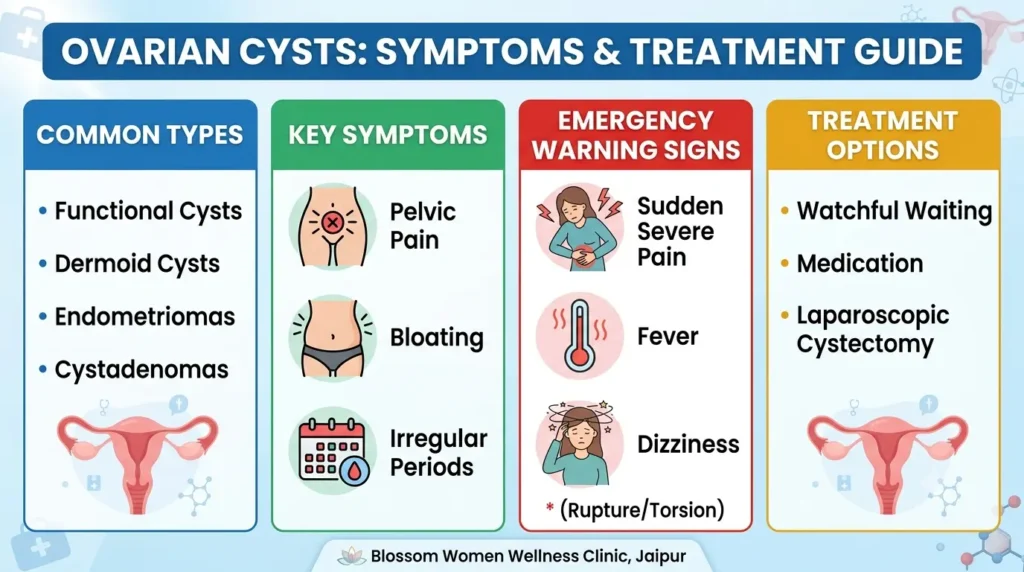
Key Symptoms to Watch For
Many small cysts cause no noticeable symptoms and are discovered incidentally during routine pelvic exams or ultrasounds. However, larger or persistent cysts can cause specific warning signs:
Pelvic pain: a dull, persistent ache or sharp pain on the side of the lower abdomen where the cyst is located.
Abdominal bloating & fullness: a frequent feeling of heaviness, pressure or swelling in the lower belly.
Pain during intercourse: discomfort or aching in the lower abdomen during or after sexual activity.
Changes in urination or bowel movements: increased frequency or urgency to urinate due to pressure on the bladder, or difficulty fully emptying the bowels.
Menstrual irregularities: unusually heavy, light or irregular periods.
Emergency warning signs: sudden, severe pelvic pain accompanied by fever, vomiting, dizziness or faintness can indicate a ruptured cyst or ovarian torsion (twisting of the ovary). These conditions require immediate emergency medical care.
Diagnosis and Treatment Options
A healthcare provider typically diagnoses an ovarian cyst using a pelvic ultrasound, blood tests (such as CA-125, if clinically indicated) or hormone level checks.
1. Watchful waiting & monitoring
Many functional cysts dissolve on their own within 1 to 3 menstrual cycles. Doctors often recommend periodic pelvic ultrasounds to track whether the cyst is shrinking or changing.
2. Medication
Hormonal contraceptives: birth control pills or hormonal devices do not dissolve existing cysts, but they prevent new cysts from forming by inhibiting ovulation.
Pain relief: nonsteroidal anti-inflammatory drugs (NSAIDs) can help manage localised discomfort.
3. Surgical intervention
Surgery is recommended if a cyst is large, persistent, painful, growing rapidly, or appears solid or complex on ultrasound imaging.
Laparoscopic cystectomy: a minimally invasive procedure to remove the cyst while preserving the ovary.
Oophorectomy: removal of the affected ovary, typically reserved for severe, recurrent or suspected complex cases.
Personalised Gynecological Care in Vaishali Nagar, Jaipur
Have concerns about lower abdominal pain or an ovarian cyst diagnosis? Schedule a consultation with Dr. Sunita Choudhary at Blossom Women Wellness Clinic.
Address: 10A, Gate No 4, Shiv Path, near SDC Aishwarya Heights, Nemi Nagar Extension, Block A, Vaishali Nagar, Jaipur, Rajasthan 302021
Call / WhatsApp: +91 9928070006
Consultations available in: English and Hindi
This article provides general medical information only and does not constitute a formal diagnosis or personalised treatment plan. For individual medical advice, please schedule a consultation.
Dr. Sunita Choudhary
MBBS, MS (Obstetrics & Gynaecology), FOGSI Member
Senior Consultant Gynecologist & Obstetrician
Blossom Women Wellness Clinic, Vaishali Nagar | Shalby Multi-Speciality Hospital, Jaipur
16 Oct 2026