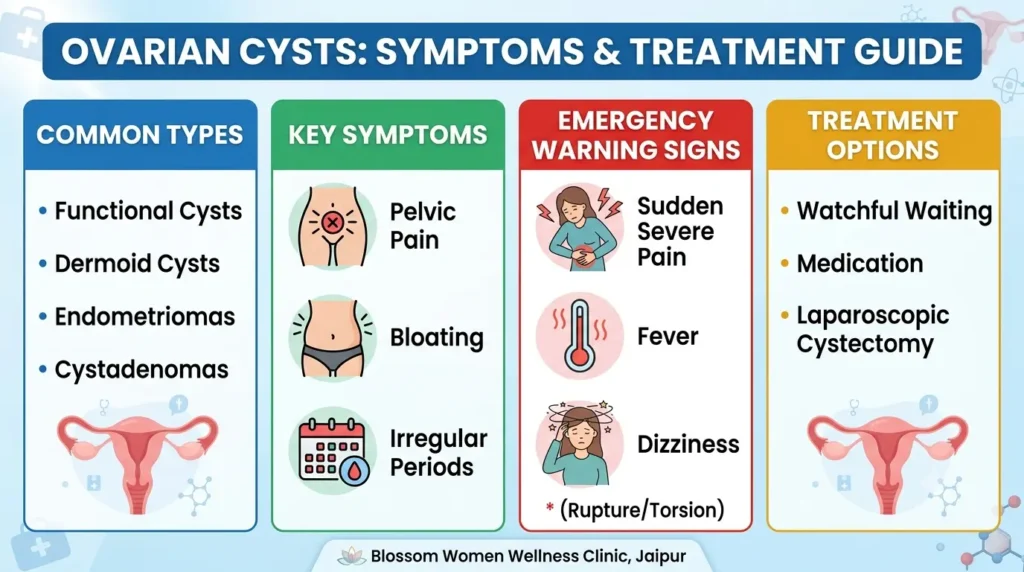
Ovarian cysts are fluid-filled sacs that develop on or inside an ovary. They are very common, many women will develop at least one during their reproductive years. While most cysts are harmless and resolve naturally without any treatment, understanding their symptoms, types and management options is essential for protecting your reproductive health. At Blossom Women Wellness Clinic in Vaishali Nagar, Jaipur, Dr. Sunita Choudhary, Sr. Consultant Gynecologist & Obstetrician, provides evidence-based, compassionate evaluation to differentiate benign functional cysts from complex conditions that require medical or surgical care. This article provides general health information. For personalised gynecological care in Jaipur, book a consultation on +91 9928070006. What Are Ovarian Cysts? An ovarian cyst is a fluid-filled sac that forms on or inside a woman’s ovary. During a normal menstrual cycle, the ovaries produce follicles that grow and release an egg during ovulation. If a follicle fails to open and release its egg, or if it re-seals after releasing the egg, fluid can build up and form a cyst. Common types of ovarian cysts Cyst type Primary cause Key characteristics Management approach Functional cysts Menstrual cycle dysfunction (follicle failure or post-ovulation closure) Includes follicular and corpus luteum cysts; usually harmless Watchful waiting; usually resolves in 1–3 cycles Dermoid cysts Formed from embryonic cells Sac-like structures that can contain hair, skin or tissue Surgical removal if growing or painful Endometriomas Endometriosis tissue growing on the ovaries “Chocolate cysts” containing old blood; cause severe pain Medical therapy or surgical excision Cystadenomas Non-cancerous growth on the outer ovary surface Filled with watery or mucous fluid; can grow large Surgical removal recommended Key Symptoms to Watch For Many small cysts cause no noticeable symptoms and are discovered incidentally during routine pelvic exams or ultrasounds. However, larger or persistent cysts can cause specific warning signs: Pelvic pain: a dull, persistent ache or sharp pain on the side of the lower abdomen where the cyst is located. Abdominal bloating & fullness: a frequent feeling of heaviness, pressure or swelling in the lower belly. Pain during intercourse: discomfort or aching in the lower abdomen during or after sexual activity. Changes in urination or bowel movements: increased frequency or urgency to urinate due to pressure on the bladder, or difficulty fully emptying the bowels. Menstrual irregularities: unusually heavy, light or irregular periods. Emergency warning signs: sudden, severe pelvic pain accompanied by fever, vomiting, dizziness or faintness can indicate a ruptured cyst or ovarian torsion (twisting of the ovary). These conditions require immediate emergency medical care. Diagnosis and Treatment Options A healthcare provider typically diagnoses an ovarian cyst using a pelvic ultrasound, blood tests (such as CA-125, if clinically indicated) or hormone level checks. 1. Watchful waiting & monitoring Many functional cysts dissolve on their own within 1 to 3 menstrual cycles. Doctors often recommend periodic pelvic ultrasounds to track whether the cyst is shrinking or changing. 2. Medication Hormonal contraceptives: birth control pills or hormonal devices do not dissolve existing cysts, but they prevent new cysts from forming by inhibiting ovulation. Pain relief: nonsteroidal anti-inflammatory drugs (NSAIDs) can help manage localised discomfort. 3. Surgical intervention Surgery is recommended if a cyst is large, persistent, painful, growing rapidly, or appears solid or complex on ultrasound imaging. Laparoscopic cystectomy: a minimally invasive procedure to remove the cyst while preserving the ovary. Oophorectomy: removal of the affected ovary, typically reserved for severe, recurrent or suspected complex cases. Personalised Gynecological Care in Vaishali Nagar, Jaipur Have concerns about lower abdominal pain or an ovarian cyst diagnosis? Schedule a consultation with Dr. Sunita Choudhary at Blossom Women Wellness Clinic. Address: 10A, Gate No 4, Shiv Path, near SDC Aishwarya Heights, Nemi Nagar Extension, Block A, Vaishali Nagar, Jaipur, Rajasthan 302021 Call / WhatsApp: +91 9928070006 Consultations available in: English and Hindi This article provides general medical information only and does not constitute a formal diagnosis or personalised treatment plan. For individual medical advice, please schedule a consultation. Dr. Sunita Choudhary MBBS, MS (Obstetrics & Gynaecology), FOGSI Member Senior Consultant Gynecologist & Obstetrician Blossom Women Wellness Clinic, Vaishali Nagar | Shalby Multi-Speciality Hospital, Jaipur
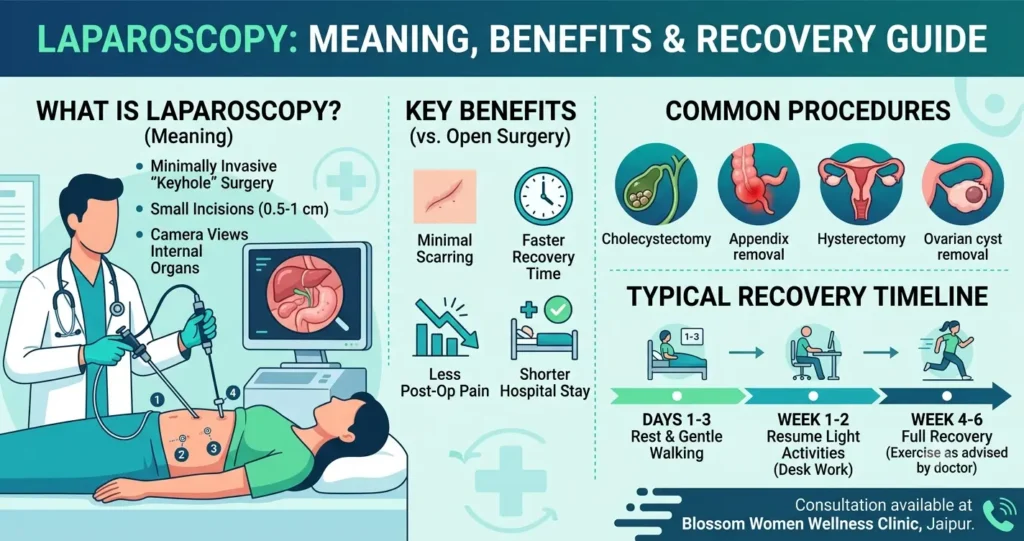
Laparoscopy, often called keyhole surgery or minimally invasive surgery, is a modern surgical technique that allows doctors to access the inside of the abdomen and pelvis without making large incisions. Using a thin, illuminated tube with a high-definition camera (a laparoscope), surgeons can diagnose and treat a wide range of conditions with increased precision, minimal tissue disruption and a much faster recovery than traditional open surgery. If you have been advised a laparoscopy, you likely have questions: What exactly happens during the procedure? How is it different from open surgery? What does it cost in Jaipur? And how long does recovery really take? This guide covers all of it, step by step. At Blossom Women Wellness Clinic in Vaishali Nagar, Jaipur, Dr. Sunita Choudhary, Sr. Consultant Gynecologist & Obstetrician, emphasises three core aspects of laparoscopic care: thorough preoperative evaluation, precise minimally invasive intervention, and clear post-operative guidelines for a smooth recovery. This article provides general health information following standards from leading gynecological bodies like the Federation of Obstetric and Gynaecological Societies of India (FOGSI). For personalised surgical consultation and care in Jaipur, book an appointment on +91 9928070006. Meaning of Laparoscopic Surgery & How It Works Laparoscopy literally means “looking inside the abdomen.” Unlike traditional open surgery (laparotomy), which requires a single large abdominal incision of typically 10 to 15 cm, laparoscopic surgery relies on 2 to 4 tiny incisions, each measuring only 0.5 cm to 1 cm. Through these small openings, the surgeon inserts the camera and miniaturised instruments and operates while watching a magnified, real-time video on surgical monitors. Laparoscopic procedure steps Anesthesia administration: the procedure is performed under general anesthesia for complete patient comfort. Carbon dioxide gas inflation: the abdomen is gently inflated with CO2 gas to create a clear viewing and working space. Insertion of the laparoscope: the high-definition camera projects magnified, real-time video to surgical monitors. Insertion of surgical instruments: miniaturised instruments complete the precise operative steps. Completion and closure: the gas is evacuated, followed by closure of the small incisions using sutures or skin adhesive. Preoperative tests & preparation Before undergoing laparoscopy, patients typically complete routine preoperative evaluations: Blood tests (complete blood count, coagulation profile, blood grouping). Diagnostic imaging (pelvic or abdominal ultrasound, CT scan or MRI). Electrocardiogram (ECG) and chest X-ray for anesthesia clearance. Pre-procedure fasting, usually 6 to 8 hours prior to surgery. Common Indications: Why Is Laparoscopy Done? Laparoscopy serves both diagnostic and operative purposes. It is widely utilised across gynecology, general surgery and urology. Gynecological procedures Laparoscopic hysterectomy (surgical uterus removal): performed for fibroids, severe bleeding or adenomyosis. Ovarian cyst and endometriosis removal: treating pain, cysts or tissue adhesions while preserving fertility. Laparoscopy for pregnancy & infertility evaluation: diagnostic assessment of blocked fallopian tubes, structural anomalies or pelvic scarring affecting conception. Ectopic pregnancy removal: treating tubal pregnancies safely. General surgery & urology Cholecystectomy: removal of the gallbladder due to gallstones. Appendectomy: removal of an inflamed appendix via laparoscopy. Hernia repair: minimally invasive reinforcement of abdominal wall defects. Kidney stone removal surgery: minimally invasive upper urinary tract stone removal. Key Benefits of Laparoscopy over Open Surgery Choosing laparoscopy over traditional open surgery offers substantial advantages for post-operative comfort and overall outcomes: Feature / Metric Minimally Invasive Laparoscopy Traditional Open Surgery (Laparotomy) Incision size 2–4 small punctures (0.5–1 cm) Large single incision (10–15 cm) Hospital stay Same-day discharge or 24 hours 2 to 4 days (or longer) Post-operative pain Mild to moderate; managed easily Moderate to severe Blood loss & infection risk Significantly lower Higher risk due to open field Recovery & rest needed 1 to 2 weeks before returning to routine 4 to 6 weeks Cosmetic scarring Tiny, barely visible scars Prominent, long scar Laparoscopic Surgery Charges & Cost Overview Understanding laparoscopic charges and insurance coverage options helps patients plan financially. The total price varies based on the procedure type, hospital choice (private vs. government hospital) and location. Laparoscopy cost in India Diagnostic laparoscopy: ₹25,000 to ₹50,000 Operative laparoscopy (e.g., appendix or gallbladder removal): ₹55,000 to ₹1,20,000 Laparoscopic hysterectomy (uterus removal): ₹75,000 to ₹1,80,000 Government hospital price lists offer highly subsidised or free procedure costs, whereas corporate private hospitals incorporate advanced equipment charges, private room rents and surgeon fees into their packages. Ask for an itemised estimate before admission so there are no surprises. Insurance & financing Insurance coverage: most health insurance plans cover medically necessary laparoscopic surgeries (e.g., hysterectomy, appendectomy, stone removal). TPA & cashless claims: check with your hospital’s insurance desk for pre-authorisation requirements. Recovery After Laparoscopic Surgery: Week-by-Week Guidelines Understanding the recovery timeline helps set realistic expectations for healing after surgery. The outline below follows a typical laparoscopic hysterectomy; simpler procedures usually follow the same pattern with faster milestones. Week 1, focus on rest & light walking Discomfort, fatigue and gas bloat are highest in the first 48–72 hours. Short walks inside the home prevent blood clots and encourage bowel movement. Week 2, gradual activity increase Pain subsides substantially; basic household or light desk activities resume. Energy levels begin returning to normal. Weeks 3–4, internal healing continues Most non-strenuous daily routines and desk work are fully restored. Deep tissue and muscle healing continue internally. Weeks 5–6, full clearance Final follow-up with your surgeon. Clearance for heavy lifting (over 5 kg), intense exercise, swimming and intercourse. Essential do’s and don’ts after laparoscopy Do’s Manage gas discomfort: walk gently around the room to help your body absorb remaining carbon dioxide gas, which can cause referred shoulder or rib pain. High-fibre diet & hydration: eat fibre-rich foods, fresh fruits and drink plenty of water to prevent constipation after anesthesia. Keep incisions dry: keep incision sites clean and dry according to your surgeon’s instructions. Take prescribed medications: follow all antibiotic and pain-relieving schedules consistently. Don’ts No heavy lifting: do not lift items heavier than 5 kg during the first 3–4 weeks. Avoid strenuous exercise: postpone high-impact cardio, gym workouts or running until cleared by your doctor. No soaking in tubs or swimming: avoid baths, hot tubs or pools until your incisions have healed completely to prevent infection. Avoid tampons or vaginal insertions: stick to sanitary pads if experiencing light post-operative spotting (common after gynaecological laparoscopy). Specialised Gynecological & Laparoscopic Care in Vaishali Nagar, Jaipur Have questions about laparoscopic surgery, hysterectomy, or recovering from a procedure? Schedule a consultation with Dr. Sunita Choudhary at Blossom Women Wellness Clinic. Address: 10A, Gate No 4, Shiv Path, near SDC Aishwarya Heights, Nemi Nagar Extension, Block A, Vaishali Nagar, Jaipur, Rajasthan 302021 Call / WhatsApp: +91 9928070006 Consultations available in: English and Hindi This article provides general medical information only and does not constitute a formal diagnosis or personalised treatment plan. For individual medical advice, please schedule a consultation. Dr. Sunita Choudhary MBBS, MS (Obstetrics & Gynaecology), FOGSI Member Senior Consultant Gynecologist & Obstetrician Blossom Women Wellness Clinic, Vaishali Nagar | Shalby Multi-Speciality Hospital, Jaipur