
Glycemic Index and Pregnancy: A Simple Guide to Low-GI Eating
Somewhere around the middle of your pregnancy, a well-meaning aunt will tell you to give up rice. Someone else will blame your sweet tooth for everything from heartburn to the baby’s size. Carbohydrates have become the villain of almost every Indian pregnancy conversation, and most of the advice you hear is confusing, contradictory, or simply wrong.
Here is the calmer truth: carbohydrates are your body’s main fuel, and your baby runs on glucose. The question is not whether to eat carbs during pregnancy, but which ones, and how quickly they release sugar into your blood. That is exactly what the glycemic index measures, and learning to use it is one of the simplest skills for a healthier pregnancy.
At Blossom Women Wellness Clinic in Jaipur, Dr. Sunita Choudhary, Sr. Consultant Gynecologist with more than 15 years of experience, discusses food at almost every antenatal visit, because blood sugar is one of the few things in pregnancy you can genuinely influence every single day. This guide explains the glycemic index in plain language, with a chart of common Indian foods and swaps from your own kitchen rather than imported diet plans.
This is general information, not a medical opinion for your specific case. For a personalised consultation, book on +91 9928070006 or visit Blossom Women Wellness Clinic, Vaishali Nagar.
What is the glycemic index?
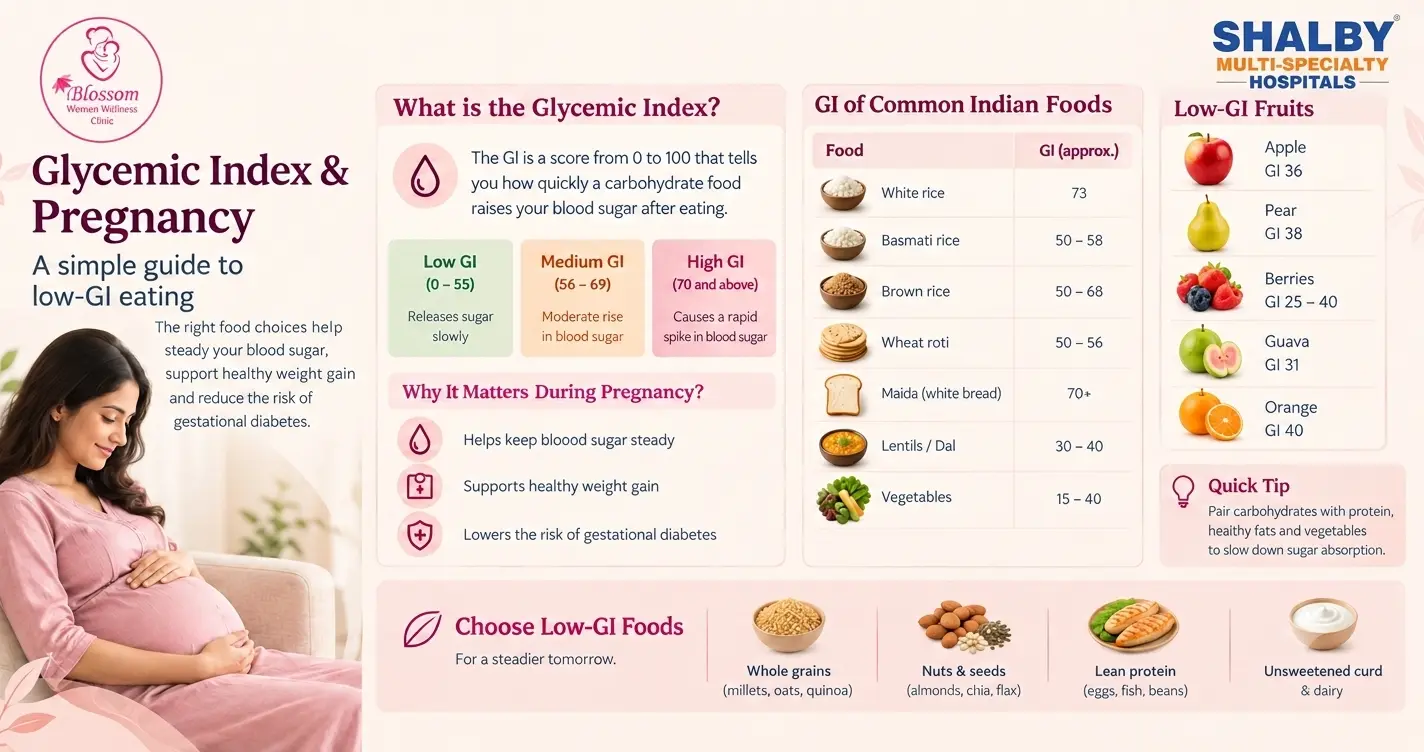
The glycemic index (GI) is a score from 0 to 100 that tells you how quickly a carbohydrate food raises your blood sugar after you eat it. Low-GI foods (55 or less) release their sugar slowly and steadily. Medium-GI foods fall between 56 and 69. High-GI foods (70 and above) flood the blood with glucose within minutes.
White bread, white rice, potatoes and sugar sit at the high end. Dals, curd, milk, most vegetables and whole fruits sit at the low end. One important nuance: the GI of a food changes when you eat it with something else. Rice eaten with dal and vegetables, after a salad, affects your blood sugar very differently from a large plate of plain rice. (You may also see the term glycemic load, or GL, which simply factors portion size into the GI; what matters most for your plate is the GI of the whole meal, not one ingredient.)
Why blood sugar matters more during pregnancy
From early pregnancy, placental hormones deliberately make your body more insulin resistant, so that glucose stays in circulation longer to feed the baby. It is a clever design, but it has a catch: in some women the pancreas cannot keep up with the extra demand, and blood sugar climbs into the range of gestational diabetes (GDM), one of the most common complications of pregnancy in India.
Uncontrolled gestational diabetes increases the chance of a larger-than-normal baby, a more difficult delivery, newborn jaundice and low blood sugar after birth, and it raises the lifetime risk of type 2 diabetes for both mother and child. Eating low glycemic index foods during pregnancy does not eliminate this risk, but it meaningfully lowers it, while also giving you steadier energy, fewer sugar crashes and healthier weight gain. Think of it as lowering the load on a system that pregnancy already makes work harder.
A glycemic index chart of common Indian foods
Values vary a little with variety, ripeness and cooking method, but this chart covers the foods Indian kitchens actually use. Download the free printable version here: Low Glycemic Index Foods List (PDF) — and keep it on the fridge:
| Food | GI (approx.) | Category |
|---|---|---|
| Dal, chana, rajma | 28 to 35 | Low |
| Curd (plain) | 11 to 15 | Low |
| Milk | 31 to 39 | Low |
| Apple | 36 | Low |
| Pear | 38 | Low |
| Orange | 43 | Low |
| Basmati rice | 50 to 58 | Low to medium |
| Brown rice | 50 to 68 | Low to medium |
| Whole-wheat atta roti | 50 to 56 | Medium |
| Steel-cut oats | 52 to 55 | Medium |
| Banana (ripe) | 51 | Medium |
| Mango | 51 to 60 | Medium |
| Table sugar | 65 | Medium to high |
| White rice | 73 | High |
| White bread / maida | 71 to 75 | High |
| Potato (boiled) | 78 | High |
| Watermelon | 72 | High (small sugar load) |
Two rows surprise almost everyone: table sugar (GI about 65) scores lower than white rice (73), and watermelon, despite its high GI, carries a small total sugar load per serving. This is why the whole plate matters more than any single food.
Low glycemic index foods to build your plate around
Building your daily meal plan around low-glycemic index foods does not require imported superfoods. Most of them are already in your kitchen:
| Instead of | Try | Why it works |
|---|---|---|
| White rice | Millets (ragi, jowar, bajra), brown rice or basmati | Intact fibre and protein slow sugar release |
| White bread or maida | Whole-wheat roti, daliya | Less refined flour means a flatter curve |
| Fruit juice | Whole fruit | Chewing whole fruit slows absorption |
| Instant or flavoured oats | Steel-cut oats, vegetable daliya, poha with peanuts | Less processing, more fibre |
| Sugar in chai, biscuits | Plain chai, roasted chana, a handful of nuts | Removes the pure sugar hits |
| Potato-heavy sabzi | Mixed vegetables with peas, beans, paneer | Lower-GI foods fill the plate |
Nothing on the left is “forbidden”. This is about proportions: fill most of the plate from the right column, and keep the left column as a smaller partner, not the main event.
The rice question: glycemic index of rice and basmati
Because rice is the heart of most Indian meals, it deserves its own answer. The glycemic index of plain white rice is high, around 73. But not all rice is equal:
- Basmati rice has a GI of roughly 50 to 58, one of the lowest among white rices; if your family cooks rice daily, switching to basmati is the single easiest change you can make.
- Brown rice sits around 50 to 68 depending on variety and cooking time; its bran layer adds fibre that slows digestion.
- Parboiled (converted) rice is digested more slowly than regular white rice.
- Cooking and cooling trick: cooking rice and refrigerating it overnight (even if you reheat it later) converts some of its starch into resistant starch, which lowers its effective GI.
However you cook it, portion is the lever that matters most in pregnancy: one small katori, eaten after a salad, with dal and sabzi, is a completely different blood-sugar event from two plates of plain rice.
Roti and the glycemic index of wheat
The glycemic index of wheat depends entirely on how much it has been refined. A whole-wheat atta roti has a moderate GI of roughly 50 to 56; refined maida products (white bread, naan, biscuits, bakery items) climb above 70. So the everyday guidance is simple: roti over bread, homemade over bakery, and always with a partner. A roti with dal and curd raises blood sugar far more gently than a roti eaten with pickle alone.
Low glycemic index fruits for pregnancy
Fruit is not forbidden in pregnancy; the trick is choosing whole fruit over juice and knowing where each fruit sits. Low glycemic index fruits include apple (36), pear (38), orange (43), guava, jamun, plums and berries. Banana (51) and mango (51 to 60) are moderate: fine in sensible portions, best eaten with nuts or curd rather than alone. Watermelon is high on the GI (about 72) but its total sugar load per serving is small, so an occasional portion is harmless. Two to three servings of whole fruit a day is a good pregnancy target.
A sample low-GI day
- Early morning: soaked almonds and a glass of water
- Breakfast: vegetable daliya or oats upma with a bowl of curd
- Mid-morning: one whole fruit (apple, guava, pear or orange) with roasted chana
- Lunch: salad first, then 2 rotis with dal, sabzi and thick curd
- Evening: sprout chaat or buttermilk with peanuts
- Dinner (light and early): 1 to 2 rotis or a small millet khichdi with paneer, egg or chicken and vegetables
- After lunch and dinner: a slow 10 to 15 minute walk
Three habits that flatten the spike
- Eating order. Vegetables, salad and protein first, carbohydrates last. Studies show this simple change lowers the post-meal sugar spike.
- Pairing. Never eat carbs alone. Dal with rice, curd with paratha, nuts with fruit: protein and fat act as a brake on sugar absorption.
- Movement. A short walk after main meals moves glucose into your muscles instead of leaving it in the blood.
The gestational diabetes test: why timing matters
Low-GI eating reduces risk, but it does not replace screening. Every pregnant woman is offered an oral glucose tolerance test (OGTT), a 75-gram glucose drink followed by a blood test, between 24 and 28 weeks. Women with risk factors (PCOS, overweight, a family history of diabetes, a previous large baby or previous gestational diabetes, or pregnancy after 35) are tested earlier, often in the first trimester.
If you are diagnosed with gestational diabetes, take heart: the same low glycemic index foods recommended for diabetics are the foundation of a gestational diabetes diet, and most women bring their numbers under control with food, walking and, when needed, medicines. The full schedule of antenatal visits and tests, including the OGTT, is covered in our antenatal checkup guide. If you have PCOS, our PCOS diet guide covers the same low-GI principles outside pregnancy, and our high-risk pregnancy guide explains how extra-risk pregnancies are monitored.
The bottom line
The glycemic index is a tool, not a list of fears. Carbohydrates are not the enemy of a healthy pregnancy; fast carbohydrates eaten alone, in large portions, all day long are. Choose slower carbs from your own kitchen, prefer basmati or brown rice and whole-wheat roti, pair carbs with protein, walk after meals, and get your sugar tested on time. Do these five things and you will have done more for your blood sugar than any exotic diet ever could.
Blood sugar in pregnancy is easiest to manage when it is planned early, not corrected late. If you are planning a pregnancy or already pregnant, a single consultation can map out your diet and screening schedule for the months ahead.
Book a consultation with Dr. Sunita Choudhary at Blossom Women Wellness Clinic, Vaishali Nagar. Call or WhatsApp +91 9928070006; same-week appointments are usually available, and you will leave with a plan, not just a prescription.
— Dr. Sunita Choudhary
Sr. Consultant Gynecologist & Obstetrician
Blossom Women Wellness Clinic, Vaishali Nagar | Shalby Multi-Speciality Hospital, Jaipur
This article is general health education, not personalised medical advice. For guidance specific to your case, book a consultation on +91 99280 70006 or message on WhatsApp.