HPV Vaccine: Age, Dosage, Side Effects and Benefits in India
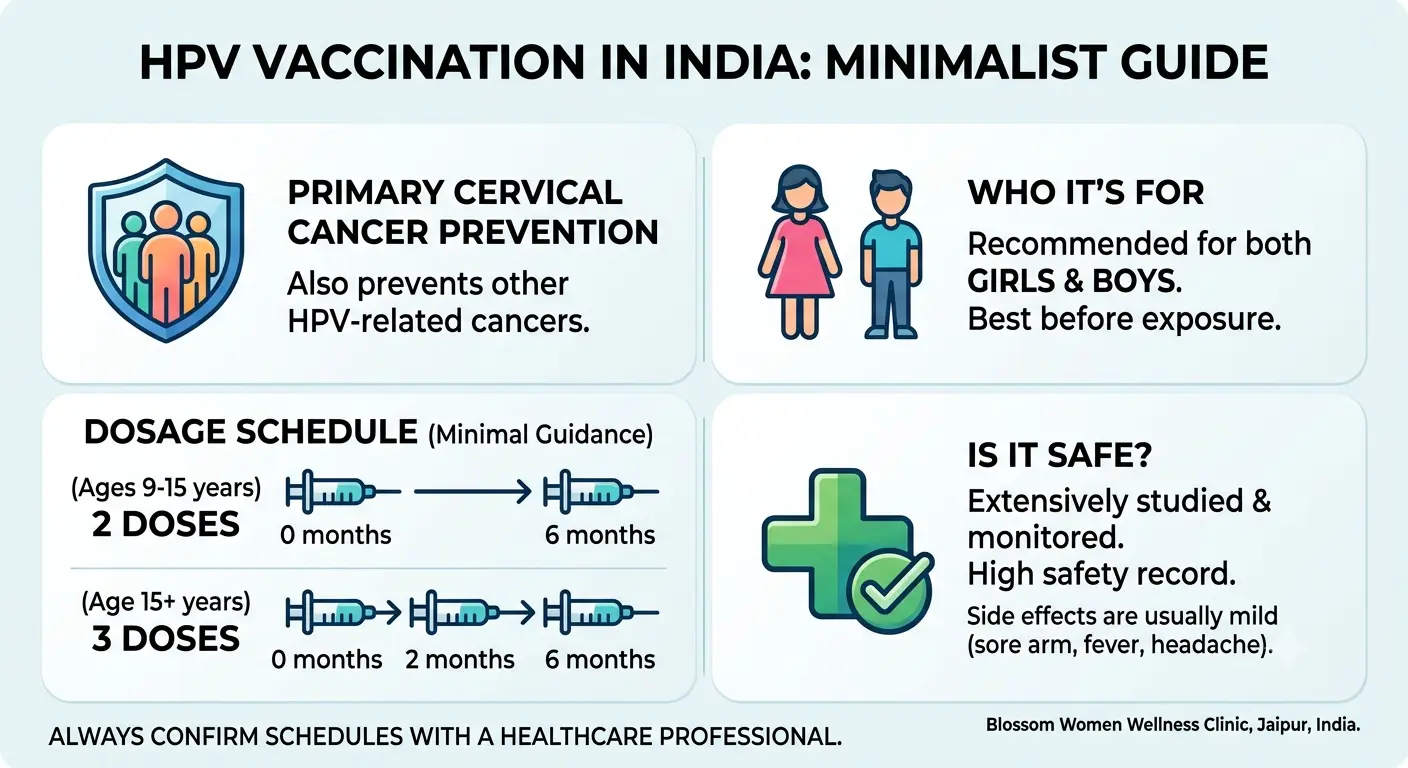
The human papillomavirus (HPV) vaccine helps protect against selected types of HPV that can cause cervical cancer and other HPV-related diseases. If you are looking for information about the HPV vaccine in India, the most important things to understand are when vaccination is recommended, how many doses may be needed, what side effects to expect, and why vaccination does not replace cervical cancer screening.
HPV vaccination is most effective when given before a person is exposed to the virus. If you are considering vaccination for yourself or your child, a qualified healthcare professional can help confirm the appropriate vaccine, age eligibility and dose schedule.
At Blossom Women Wellness Clinic in Vaishali Nagar, Jaipur, Dr. Sunita Choudhary, Sr. Consultant Gynecologist & Obstetrician, counsels women and parents about HPV vaccination — including eligibility, dose schedules, and how vaccination fits alongside regular cervical cancer screening. The clinic can be contacted to enquire about HPV vaccination counselling, current product availability and pricing.
This article provides general health information. For personalised guidance about HPV vaccination or cervical cancer screening in Jaipur, book a consultation on +91 9928070006.
What is HPV?
Human papillomavirus (HPV) is a group of viruses. Some types can infect the skin or moist surfaces of the body, including the genital area, and are commonly transmitted through intimate skin-to-skin or sexual contact. Many HPV infections clear naturally, but persistent infection with certain high-risk types can lead to cervical cancer. HPV is also associated with some cancers of the vulva, vagina, penis, anus and oropharynx. Other HPV types can cause genital warts.
HPV infection is common and can affect people of any gender. Having HPV is not, by itself, proof of infidelity or poor hygiene.
What does the HPV vaccine do?
HPV vaccines train the immune system to recognise selected HPV types before a person is exposed to them. They are preventive vaccines: they help prevent new infections but do not treat an existing HPV infection, genital warts or cancer.
Depending on the product, vaccination can help prevent infection from HPV types responsible for a large proportion of cervical cancers. Some vaccines also cover types associated with genital warts. No HPV vaccine covers every HPV type, which is one reason cervical screening remains important.
The World Health Organization (WHO) identifies HPV vaccination as a key part of cervical cancer prevention. Read the WHO HPV vaccine guidance.
At what age should you get the HPV vaccine?
HPV vaccination is generally prioritised in early adolescence, before exposure to HPV. The right age and schedule for an individual depend on the vaccine product, age at the first dose, immune status and the guidance applicable in India.
FOGSI’s published Immunization Schedule for Adult Women lists the following schedule:
| Age when starting vaccination | Schedule listed by FOGSI |
|---|---|
| 9–15 years | 2 doses: first dose at month 0 and second dose at month 6 |
| 15 years and older | 3 doses: at months 0, 2 and 6 |
This is a summary of the cited FOGSI document, not a substitute for an individual prescription. The FOGSI document notes that its protocol may be updated in relation to WHO’s alternative single-dose recommendation and Indian regulatory approval. Do not assume that a one-dose schedule applies to every person or product. Ask a clinician to confirm the current Indian recommendation for your age and vaccine.
Source: FOGSI — Adult Women Immunization Schedule (PDF).
Is 25 too late for the HPV vaccine?
Not necessarily. Being 25 does not automatically mean vaccination is inappropriate. The potential benefit depends on factors such as previous vaccination, age, likely prior exposure and the vaccine’s approved indication. Vaccination usually provides the greatest benefit before exposure to HPV, so discuss your circumstances with a clinician rather than assuming it is either too late or definitely needed.
Can someone get the HPV vaccine after becoming sexually active?
Yes, sexual activity does not automatically rule out vaccination. However, the vaccine cannot clear an HPV infection that has already occurred, and its benefit may be lower if a person has already been exposed to some of the HPV types covered by the vaccine. A clinician can explain whether vaccination is likely to be useful for you.
How many doses of the HPV vaccine are needed?
There is no single schedule that applies to every person in every circumstance. The number and timing of doses can depend on:
- Age at the first dose.
- The vaccine product used.
- Whether the person has an immune condition or is immunocompromised.
- Current Indian recommendations and product-specific instructions.
- Whether any doses have already been received.
Keep a record of the vaccine name and each dose date. If a dose is delayed, ask the vaccinating clinician how to continue the series; do not restart or change the schedule without advice.
Which HPV vaccines are available in India?
HPV vaccines differ in the number of HPV types they target. Product availability, licensed age ranges and indications can change, so confirm what is currently available through a qualified healthcare professional.
| Vaccine type | What the type means |
|---|---|
| Bivalent | Targets two high-risk HPV types, commonly types 16 and 18 |
| Quadrivalent | Targets HPV types 6, 11, 16 and 18; types 6 and 11 are associated with most genital warts |
| Nonavalent (9-valent) | Targets nine HPV types: 6, 11, 16, 18, 31, 33, 45, 52 and 58 |
Brand names commonly discussed include Cervarix (bivalent), Gardasil (quadrivalent), Gardasil 9 (nonavalent) and Cervavac (quadrivalent). This list is for general education and does not confirm current local stock, availability or eligibility at any particular clinic.
Gardasil 9 vs Cervarix vs Cervavac: which is better?
These products do not target exactly the same HPV types. Gardasil 9 covers nine types, while Cervarix targets two high-risk types and quadrivalent products such as Gardasil and Cervavac target four types. That difference alone does not determine which product is best for an individual.
The appropriate choice depends on the product’s current Indian approval and availability, the patient’s age and clinical circumstances, and the clinician’s recommendation. Ask the clinic to confirm the product name, types covered, licensed age range, schedule and total cost before vaccination.
Is the HPV vaccine safe?
HPV vaccines have been studied and monitored extensively and have a reassuring safety record. As with any vaccine, side effects can occur. The benefits and risks should be discussed with a healthcare professional, especially if the person has had a severe allergic reaction to a previous dose or a vaccine ingredient.
What are the common side effects?
Commonly reported effects include:
- Pain, redness or swelling where the injection was given.
- Headache or tiredness.
- Mild fever, nausea or muscle aches.
- Dizziness or fainting around the time of vaccination.
These effects are usually short-lived. Adolescents should be vaccinated while seated or lying down and observed afterwards to reduce the risk of injury if they faint.
A severe allergic reaction is rare but requires urgent medical care. Seek emergency help for symptoms such as difficulty breathing, swelling of the face or throat, or collapse after vaccination.
For further information, see the CDC’s HPV vaccine safety guidance.
Can the HPV vaccine cause infertility?
Available safety evidence has not shown that HPV vaccination causes infertility. Preventing HPV-related precancerous changes and cancers may help reduce the risk of needing treatments that can affect future fertility. If you have concerns about fertility, discuss them with your clinician and ask them to explain the evidence and any individual precautions.
Can the HPV vaccine be given during pregnancy?
HPV vaccination is generally deferred during a known pregnancy. If a person discovers they are pregnant after receiving a dose, they should inform their healthcare professional; inadvertent vaccination is not, by itself, a reason to panic. Any remaining doses are generally postponed until after pregnancy. Ask your clinician for advice specific to your situation.
Can men get the HPV vaccine?
HPV vaccination can also benefit males by preventing infections caused by vaccine-targeted HPV types. These types are associated with some anal, penile and oropharyngeal cancers, and certain types can cause genital warts.
However, approved age ranges and indications differ by product and country. In India, confirm the relevant product’s approved indication and whether vaccination is appropriate for the person with a qualified clinician.
Does HPV vaccination prevent every case of cervical cancer?
No vaccine prevents every case. HPV vaccines protect against selected types of HPV that cause a large proportion of cervical cancers, but they do not cover every cancer-causing type and do not treat infections acquired before vaccination.
Vaccination should therefore be considered one part of prevention, alongside appropriate cervical cancer screening and follow-up of abnormal results.
Does the HPV vaccine replace a Pap smear or HPV test?
No. Vaccination does not replace recommended cervical cancer screening. A Pap test looks for abnormal cervical cells, while an HPV test looks for high-risk HPV types. Which screening test is appropriate and when to begin depends on current local guidance, age and medical history.
If you have symptoms or have previously had an abnormal screening result, seek medical advice rather than relying on vaccination alone.
HPV vaccine and cost in India
The price of HPV vaccination varies according to the product, provider, number of doses and any consultation or administration charges. Because schedules may require more than one dose, ask for the total course cost, not only the price of one injection.
Before booking, confirm:
- The exact vaccine brand and product.
- The price per dose and expected total cost.
- The number of doses recommended for the person’s age and circumstances.
- Whether the vaccine is currently in stock.
- The appointment process and any consultation charges.
Do not rely on an old online price as a guarantee of current cost. Ask the clinic or vaccination provider for a current quote.
Where can you enquire about HPV vaccination in Jaipur?
If you are looking for HPV vaccination guidance in Jaipur, contact Blossom Women Wellness Clinic in Vaishali Nagar to ask about consultation, current vaccine availability, eligibility and pricing.
- Address: 10A, Gate No 4, Shiv Path, near SDC Aishwarya Heights, Nemi Nagar Extension, Block A, Vaishali Nagar, Jaipur, Rajasthan 302021
- Call / WhatsApp: +91 9928070006
- Website: blossomwellness.in
Please call before visiting to confirm current clinic hours, vaccine stock, product availability and the appointment process.
Sources and further reading
- World Health Organization (WHO): Human papillomavirus (HPV) vaccines
- FOGSI: Immunization Schedule for Adult Women (PDF)
- CDC: HPV Vaccine Safety
- CDC: HPV Vaccination Recommendations
This article is for general educational purposes and does not replace an individual consultation, diagnosis or treatment plan. Vaccine approvals, availability and schedules can change. Confirm the current recommendation for your age, health history and vaccine product with a qualified healthcare professional.
— Dr. Sunita Choudhary
MBBS, MS (Obstetrics & Gynaecology), FOGSI Member
Senior Consultant Gynecologist & Obstetrician
Blossom Women Wellness Clinic, Vaishali Nagar | Shalby Multi-Speciality Hospital, Jaipur
This article is general health education, not personalised medical advice. For guidance specific to your case, book a consultation on +91 99280 70006 or message on WhatsApp.