The reminder lands quietly: your Pap test is due. Or you are at a routine checkup when the doctor mentions, almost in passing, that a screening test for cervical cancer should be done. For many women the reaction is the same, a small flicker of fear (the word cancer will do that), a moment of embarrassment, and a quiet decision to think about it later. Screening gets postponed for years this way, most often by women who feel completely healthy and see no reason to lie down on an examination table for a test nobody has properly explained.
Here is the truth we wish every woman knew: cervical cancer is one of the few cancers we can realistically prevent, and screening is how. It does not arrive overnight. The cells of the cervix change slowly, usually over ten to fifteen years, passing through a precancerous stage that a simple clinic test can catch and treat long before it ever becomes cancer. Nearly every case begins with a common virus called human papillomavirus (HPV), and we now have both a test that finds it and a vaccine that prevents it.
At Blossom Women Wellness Clinic in Jaipur, Dr. Sunita Choudhary, Sr. Consultant Gynecologist with more than 15 years of experience, believes a well-timed screening test is one of the most powerful decisions a woman can make for her future self. This guide explains everything you have been searching about cervical cancer screening: how the Pap smear differs from the HPV test, when to start and how often to go, what an abnormal result actually means, and the full picture on the HPV vaccine for cervical cancer, the right age, the doses, the price in India and its side effects.
This is general information, not a medical opinion for your specific case. For a personalised consultation, book on +91 9928070006 or visit Blossom Women Wellness Clinic, Vaishali Nagar.
What is cervical cancer, and what causes it?
The cervix is the lower, narrow part of the uterus (womb) that opens into the vagina. Cervical cancer begins when cells there start growing abnormally and out of control. It is the second most common cancer among Indian women, with roughly 1.2 lakh new cases and around 77,000 deaths in the country every year, a number made larger by one uncomfortable fact: most Indian women are diagnosed late, after symptoms have already appeared.
So what causes cervical cancer? More than 9 in 10 cases trace back to a single cause: a persistent infection with a high-risk type of HPV. HPV is an extremely common virus passed through skin-to-skin sexual contact, so common that most adults will catch some strain of it at some point, the way one catches a cold. In the great majority of people the immune system clears it within a year or two without a single symptom. Cancer develops only when a high-risk type is not cleared and quietly persists, and even then the change is slow, usually taking ten to fifteen years. That long window is exactly what makes screening and vaccination so effective: you do not have to catch the cancer, you only have to catch it on the way.
Why screening matters so much
Cervical cancer in its early and precancerous stages causes no symptoms at all. Nothing to feel, nothing to see, which is precisely why waiting for symptoms is the wrong strategy for this particular cancer.
When cervical cancer is caught at an early stage, more than 9 in 10 women are alive five years later. Found late, that number falls sharply. This is the gap that screening closes. A Pap smear or HPV test is not really a cancer test, it is a cancer-prevention test. It looks for the precancerous changes that can be treated in a clinic in minutes, so that the cancer itself never gets the chance to exist.
Pap smear vs HPV test: what is the difference?
Both tests are done the same way: you lie on the examination table, a small instrument called a speculum is gently placed so the doctor can see the cervix, and a soft brush takes a sample of cells in a few seconds. The whole sampling takes under a minute and is uncomfortable at most, not painful.
| Pap smear | HPV test | |
|---|---|---|
| What it checks | Cells from the cervix, examined under a microscope | DNA of high-risk HPV types in the sample |
| What it finds | Cell changes HPV has already caused | The virus itself, before changes appear |
| From what age | From 21 | From 30 (some guidelines from 25) |
| How often | Every 3 years | Every 5 years |
| Self-sample option | No | Possible in some settings |
The sampling experience is identical for you; the difference lies in what the laboratory looks for. The Pap smear finds the damage HPV has caused, while the HPV test finds the cause itself, often years earlier. That is why, from age 30, an HPV test every five years has become the preferred screening option, and ask your clinic whether HPV self-sampling is available, because it removes the examination room from the equation entirely.
When should you start cervical cancer screening?
Start at age 21 if you have ever been sexually active. That is the recommendation of the major international guidelines, and it is what we advise at our clinic. A few Indian professional bodies suggest beginning at 25 or 30, but we have occasionally seen precancerous changes in women in their early twenties, and the test is quick and inexpensive, starting at 21 is simply the safer choice.
Screening may need to start earlier than 21, or happen more often, if:
- Your immunity is reduced (an organ transplant, untreated HIV, or long-term medicines that suppress the immune system)
- You have had a previous abnormal Pap or HPV result
- You have bleeding that is not normal for you, at any age, this needs a doctor, not a screening schedule
If you have never been sexually active, your risk is very low; discuss the timing with your gynecologist rather than skipping the conversation altogether.
How often do you need screening?
| Your situation | How often |
|---|---|
| Age 21 to 29 | Pap smear every 3 years |
| Age 30 to 65 | HPV test every 5 years (preferred), or Pap + HPV together every 5 years, or Pap alone every 3 years |
| Over 65 | You may be able to stop, if your recent tests have been normal |
| Hysterectomy (cervix removed, not for cancer) | No screening needed |
| After HPV vaccination | Screening continues exactly as above |
One line deserves emphasis: a normal test does not mean never again. The tests look for changes that develop over years, so a clear result is a ticket for the next round, not a lifetime pass. Most cervical cancers found in India occur in women who were never screened or who let years slip by. If it has been more than three years since your last Pap, or five since your last HPV test, that is your reminder.
What an abnormal result actually means
The phone call comes, the words abnormal result are said, and the mind leaps straight to cancer. Take a breath. An abnormal Pap result does not mean you have cancer. The overwhelming majority of abnormal results show mild cell changes or simple inflammation, and cancer is the rarest cause of all. Results are graded, and the grade decides what happens next:
- ASC-US, the most common abnormal result. Mild changes, often from HPV or plain inflammation. Usually followed by a repeat test or an HPV test.
- LSIL (low-grade), mild HPV-related changes. In most women the immune system clears these; they are monitored, not rushed to treatment.
- HSIL (high-grade), a more serious precancerous change. Needs colposcopy and treatment so it never becomes cancer.
- AGC, changes in gland cells; less common and always checked more closely.
An HPV-positive result is not a diagnosis of disease either. If the type found is HPV 16 or 18, the two types responsible for most cervical cancers, your doctor will usually recommend a colposcopy directly. If it is another high-risk type, a reflex Pap test or a repeat test in twelve months sorts out who needs a closer look.
And colposcopy itself is simpler than the name suggests: a ten-to-twenty-minute clinic visit where the cervix is examined under magnification, with a tiny, painless biopsy taken only if something looks suspicious. If a precancerous change is confirmed, removing it is a short outpatient procedure (LLETZ, a thin wire loop under local anaesthesia) that preserves the uterus and fertility. This is the exact sequence by which cervical cancer is prevented.
In a well-screened population, cervical cancer among women who attend regularly is rare. Treat an abnormal result as what it is: an invitation for a closer look, not a verdict.
The HPV vaccine: age, doses, price and side effects
Screening finds the disease late in its making; the HPV vaccine for cervical cancer stops the process from ever starting. It works by training the immune system against the high-risk HPV types, above all 16 and 18, that cause roughly 70 to 90 percent of cervical cancers.
What is the right age for the HPV vaccine?
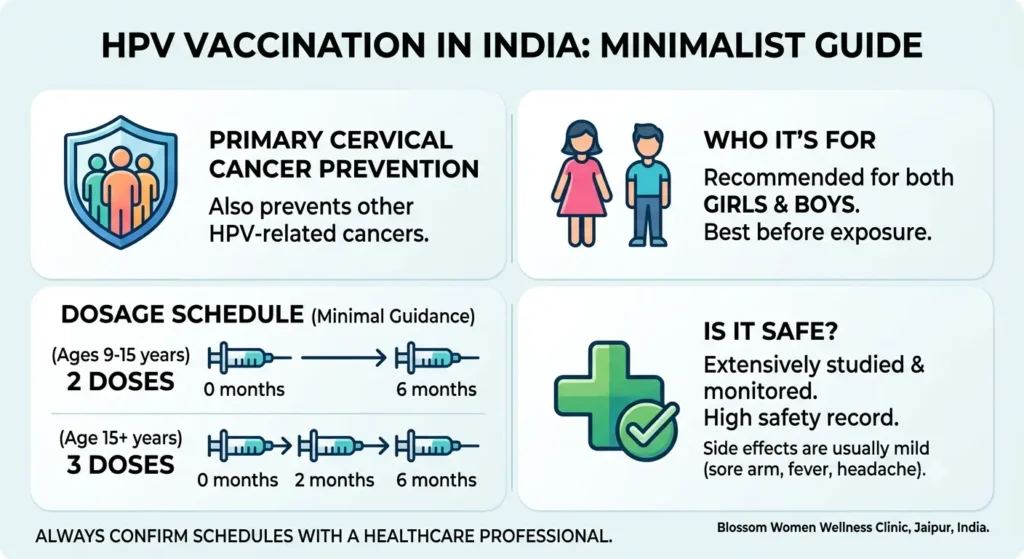
The ideal age is 9 to 14 years, when just two doses about six months apart are needed and the immune response is strongest. From 15 up to 26 years, three doses are advised as catch-up vaccination. Between 27 and 45, the vaccine can still be discussed with your gynecologist case by case.
Because the vaccine works best before first exposure to HPV, giving it to girls in school age is the highest-impact move a family can make. But if you are an adult reading this: the vaccine still protects against types you have not yet caught, so being sexually active does not make it pointless. Two honest limits: it does not treat an HPV infection you already have, and it never replaces screening.
How much does the HPV vaccine cost in India?
India now has its own vaccine: Cervavac, made by the Serum Institute of India, which protects against four HPV types and costs around ₹2,000 per dose at private hospitals; imported versions (Gardasil) protect against more types and cost more per dose. If you have been searching for the cervical cancer vaccine price in government hospitals, the honest answer is this: under national immunisation drives, eligible girls are vaccinated free of cost, and government hospitals and Ayushman centres often offer the vaccine at heavily subsidised rates. Prices change and stock varies, so call your nearest centre or our clinic and confirm the current schedule before you go.
What are the side effects of the cervical cancer vaccine?
The side effects of the cervical cancer vaccine are usually mild and settle within a day or two: pain, redness or swelling where the injection was given, a mild fever, headache, tiredness or nausea. Teenagers occasionally feel faint after any injection, which is why you will be asked to sit for 15 to 20 minutes after the dose. Serious allergic reactions are very rare, on the order of about one in a million doses, and treatable when they happen.
Then there are the myths, because this vaccine has collected more than its share. Claims that it causes infertility, PCOS or period problems have been examined in studies covering hundreds of millions of doses worldwide, and no such link exists; the WHO’s global safety reviews have repeatedly confirmed the vaccine’s safety. What the vaccine genuinely does is prevent a cancer, that is the side effect worth remembering.
How to prevent cervical cancer: putting it all together
How to prevent cervical cancer is a short list, and every item on it is practical:
- HPV vaccination at the right age, the single most effective step, ideally for girls aged 9 to 14
- Regular screening, a Pap smear or HPV test on schedule from age 21, even after vaccination
- Condoms, they reduce (though do not eliminate) HPV transmission
- Not smoking, smoking weakens the immune system’s ability to clear HPV
This is why the WHO has a credible plan to eliminate cervical cancer this century: vaccinate 90 percent of girls, screen 70 percent of women, and treat 90 percent of precancerous changes. Cervical cancer may be the second most common cancer in Indian women, but it is the one where a woman’s own two decisions, vaccination and screening, matter most.
Warning signs that should never wait for your next screening date
Many women describe learning they had this disease in phrases like how I knew I had cervical cancer, and nearly every story begins the same way, with bleeding that was not normal for them. Symptoms of cervical cancer to take seriously:
- Bleeding between periods, after sex, or after menopause
- Watery, blood-stained or foul-smelling vaginal discharge
- Persistent pelvic pain or pain during sex
- In advanced disease: back or leg pain, leg swelling, unexplained weight loss
These symptoms are far more often caused by less serious conditions, infections, polyps, hormonal changes, but they always deserve a check, not a wait. And if your cycles were already irregular before any of this appeared, start with our guide to irregular periods: causes and care, then book the examination. Screening is for when you feel fine; symptoms are for the doctor, now.
Cervical cancer screening in Jaipur
At Blossom Women Wellness Clinic in Vaishali Nagar, we make cervical screening as comfortable and private as it should be: Pap smear, HPV testing, vaccination counselling for daughters and mothers alike, and colposcopy when something needs a closer look, all explained before anything happens, most visits finished in under thirty minutes.
If you are 21 or older and have never been screened, book that appointment today. Call or WhatsApp +91 9928070006; same-week appointments are usually available.
The bottom line
Cervical cancer is caused by a virus, grows slowly, and announces itself on a screening test years before it causes a single symptom. Start at 21 with a Pap every three years; from 30, add or switch to HPV-based testing every five years; vaccinate at 9 to 14 where possible and catch up by 26, and never skip the follow-up after an abnormal result, because that follow-up is precisely how this cancer is stopped.
A cervical screening test takes minutes; what it protects is decades. It may be the most valuable half-hour a woman ever gives her future self.
If anything in this guide applies to you, a test that is overdue, a result that was never followed up, a daughter approaching vaccine age, book a consultation with Dr. Sunita Choudhary at Blossom Women Wellness Clinic, Vaishali Nagar. Call or WhatsApp +91 9928070006.
Dr. Sunita Choudhary
Sr. Consultant Gynecologist & Obstetrician
Blossom Women Wellness Clinic, Vaishali Nagar | Shalby Multi-Speciality Hospital, Jaipur
This article is general health education, not personalised medical advice. For guidance specific to your case, book a consultation on +91 99280 70006 or message on WhatsApp.