Another month, another single line on the test. Your periods have never been regular, the tracking app has given up guessing, and every pregnancy announcement on your feed lands a little harder than the last. Somewhere between the aunties’ advice and the internet’s horror stories, a quiet fear has taken root: does PCOD mean I cannot be a mother?
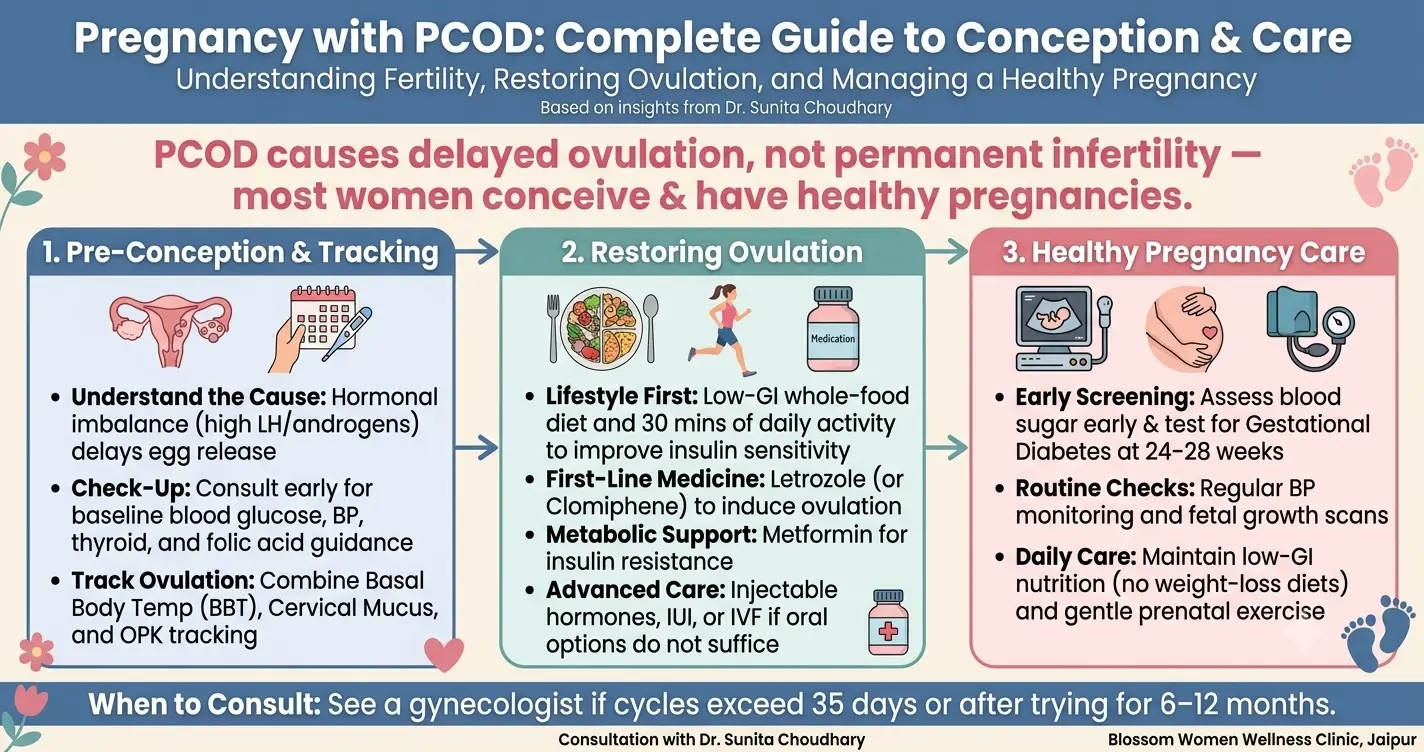
Here is the reassuring truth: having PCOD (Polycystic Ovarian Disease) can make conceiving more challenging, but it does not mean permanent infertility. A quick note on terms: PCOS (Polycystic Ovary Syndrome) is the internationally recognised clinical terminology, while PCOD is the label more commonly used in India and in patient searches, this guide uses PCOD, and the care approach applies to both. PCOD affects fertility primarily by causing anovulation, irregular or absent ovulation, so eggs are not released predictably each month. Once ovulation is restored, often through simple lifestyle adjustments or mild clinical guidance, conception rates are high. The path from diagnosis to a positive test is usually shorter and less dramatic than the fear suggests.
At Blossom Women Wellness Clinic in Jaipur, Dr. Sunita Choudhary, Sr. Consultant Gynecologist with more than 15 years of experience, walks many women with PCOD from their first irregular cycle to their first scan with a heartbeat. This guide lays out that same path step by step, the PCOD and fertility connection explained plainly, how to restore ovulation naturally, how to track your fertile window when cycles are unpredictable, and which medical treatments are available if you need them.
This is general information, not a medical opinion for your specific case. For a personalised consultation, book on +91 9928070006 or visit Blossom Women Wellness Clinic, Vaishali Nagar.
PCOD and fertility: why does PCOD affect conception?
To get pregnant, an ovary must release a mature egg that sperm can fertilise. In PCOD, three linked disruptions get in the way:
- Irregular ovulation. Unbalanced luteinizing hormone (LH) and androgen levels keep eggs from fully maturing, leading to skipped cycles, no mature egg, no conception that month.
- Insulin resistance. Elevated insulin impairs egg quality and interferes with egg release, which is why insulin sits at the centre of both the PCOD problem and its treatment.
- Reduced progesterone exposure when ovulation is irregular. When ovulation does not occur regularly, the normal progesterone rise after ovulation may be absent or inconsistent, and progesterone is the hormone that prepares the uterine lining for embryo implantation.
Notice the pattern: none of this is permanent damage. It is a hormonal environment that can be changed.
“PCOD causes delay in ovulation, not a permanent stop. Period late hone ka matlab yeh nahi ki aap kabhi maa nahi ban sakti. With the right ovulation plan, most women conceive naturally.”, Dr. Sunita Choudhary
Before trying to conceive with PCOD
A preconception check-up sets the stage for everything that follows. Book one a few months before you start trying, and use it to:
- Review your PCOD diagnosis and any current medicines, some need adjusting or stopping before pregnancy.
- Record baseline blood pressure, blood glucose and metabolic markers, so changes during pregnancy have a reference point.
- Start folic acid at least one to three months before conception, as your doctor advises.
- Update vaccinations and settle the lifestyle basics, sleep, no smoking, no alcohol.
- Discuss individualised weight management if that is relevant for you.
- Check thyroid and other conditions that often travel with PCOD and can affect pregnancy.
- Mention how long you have been trying, so fertility factors on either side are assessed without delay.
Step 1: Restore ovulation naturally
Planning pregnancy with PCOD follows a natural progression from self-care habits to targeted medical intervention, and the first step is the most powerful:
- Focus on healthy weight, not a fixed target. If you are overweight, even modest, individualised weight management may improve menstrual regularity, ovulation and metabolic health. However, not every woman with PCOD needs to lose weight to improve fertility, and fertility treatment should be tailored to the individual.
- Adopt an anti-inflammatory, low-GI diet. Base meals around whole grains, lean proteins, healthy fats and high-fiber vegetables to lower fasting insulin levels. Our PCOS diet guide covers the exact foods, meal plans and swaps.
- Engage in regular movement. Regular physical activity can improve overall metabolic health and insulin sensitivity and should be part of a healthy preconception routine, a brisk 30-minute walk most days, or combined aerobic exercise and light resistance training, all count. No single diet or exercise regimen has been proven uniquely superior for PCOD; consistency is what matters.
These are precisely the principles our PCOS & hormonal health programme is built on: doctor-guided, food-first, and shaped around Indian kitchens.
Step 2: Track your fertile window
Because PCOD cycles can be unpredictable, standard calendar apps are often inaccurate. Layer these signals instead:
- Basal body temperature (BBT). Measure your temperature every morning before getting out of bed. A slight, sustained rise (about 0.5°F) after the fertile window provides a useful indication that ovulation has occurred.
- Cervical mucus monitoring. Look for clear, stretchy “egg-white” mucus in the days before ovulation, it signals peak fertility.
- Ovulation predictor kits (OPKs). One PCOD-specific caveat: elevated baseline LH can yield false-positive OPK results. Pair the kits with cervical mucus and BBT tracking, this may improve interpretation of your fertile window.
Step 3: Medical treatment for ovulation
If lifestyle steps have not normalised your cycle within 3 to 6 months, targeted ovulation-inducing therapies are the next rung:
- Letrozole. The recommended first-line medicine for ovulation induction in PCOD-related anovulatory infertility, when there are no other infertility factors.
- Clomiphene citrate. May be used in some situations when letrozole is unsuitable or unavailable.
- Metformin. May be prescribed for metabolic features such as insulin resistance or impaired glucose regulation; in selected women with PCOD, it may also have a role in fertility treatment, depending on the overall clinical picture.
- Gonadotropin therapy. Injectable hormones for cases where oral medications have not led to ovulation or pregnancy, used under close pelvic ultrasound monitoring.
- Assisted reproduction. If ovulation-induction treatment does not result in pregnancy, or if other fertility factors are present, options such as IUI (Intrauterine Insemination) or IVF may be considered, depending on your fertility evaluation.
When should you see a doctor if you have PCOD and want to get pregnant?
Self-care is the right first move, but it is not the only move. Book a consultation rather than waiting when any of these apply:
- Irregular or absent periods. Cycles longer than 35 days, or no period for 3 months or more, deserve an ovulation check rather than a wait-and-see approach.
- Known PCOD with difficulty conceiving. If you have a PCOD diagnosis and have not conceived after 6 months of well-timed attempts, ovulation-inducing treatment may shorten the journey.
- Age 35 or older. Fertility declines with age in all women, so see a specialist after 6 months of trying rather than waiting a full year.
- Previous fertility problems. Prior fertility investigations, treatment or pregnancy loss justify an earlier, more thorough evaluation.
- Possible other fertility factors. A history of pelvic infection, surgery or severe period pain in either partner can point to tubal or sperm factors; both partners are part of the evaluation.
- Prolonged attempts. Under 35 and trying for 12 months without success? A fertility evaluation is the standard recommendation at that point.
Pregnant with polycystic ovaries: what happens after you conceive
Most women with PCOD who become pregnant go on to have healthy pregnancies, but PCOD is associated with higher risks of certain pregnancy complications, so appropriate antenatal monitoring is important. The insulin resistance and hormonal pattern associated with PCOD are believed to contribute to these risks, and whether you are pregnant with PCOS or PCOD, the care plan is the same.
PCOD is associated with a higher risk of several pregnancy complications. This does not mean these complications will occur, but it is one reason your obstetric team may recommend closer monitoring:
- Early miscarriage. PCOD is associated with a modestly higher risk of early pregnancy loss. The recommended focus before conception is appropriate preconception care, healthy lifestyle habits and management of blood glucose and blood pressure; once pregnant, early and regular antenatal appointments matter most.
- Gestational diabetes. A common PCOD-related pregnancy complication, because insulin resistance naturally worsens in later pregnancy. Doctors typically assess blood sugar early in pregnancy and again with a glucose tolerance test around 24 to 28 weeks, our glycemic index and pregnancy guide explains how lower-glycemic food choices can support healthy blood-sugar management during pregnancy.
- Blood pressure and preeclampsia. Slightly raised odds, checked at every antenatal visit with a blood pressure cuff and a urine dipstick.
- Preterm birth and larger-than-normal babies. Watched through routine growth scans, not something you manage at home.
What good pregnancy with PCOD care looks like in practice:
- Tell your doctor about your PCOD at the very first antenatal visit, so the dating scan and monitoring plan account for it.
- Keep the low-GI plate, adjusted for pregnancy: the same dal, vegetables and whole grains, with pregnancy-appropriate portions. Do not diet to lose weight while pregnant.
- Stay active with safe movement, options such as 30-minute walks and prenatal yoga may be suitable depending on your individual pregnancy circumstances.
- Take folic acid and any other supplements exactly as prescribed, and attend the glucose testing your doctor recommends.
- If you have added risk factors, your doctor may schedule more frequent visits; our high-risk pregnancy guide explains how extra-care pregnancies are monitored.
One more reassurance for the months after: breastfeeding itself improves insulin sensitivity, and many of the lifestyle habits you built while trying to conceive simply continue into motherhood. PCOD care does not end at a positive test, it just changes uniforms.
Planning pregnancy with PCOD: your checklist
| Step | Focus Area | Goal |
|---|---|---|
| Step 1 | Diet & Insulin | Low-glycemic meals, lower sugar, stabilised insulin levels |
| Step 2 | Pre-Conception Care | Start folic acid as recommended by your doctor before conception and continue prescribed supplements during pregnancy |
| Step 3 | Ovulation Tracking | Monitor cervical mucus and morning BBT |
| Step 4 | Medical Consultation | Consult a gynecologist or fertility specialist when the signs above apply, pregnancy monitoring is tailored to individual risk factors |
Planning to Conceive with PCOD? Get our free PCOD Fertility & Ovulation Tracking Guide (PDF), step-by-step instructions on tracking basal body temperature and cervical mucus when your periods are irregular. Click here to receive it on WhatsApp.
The bottom line
PCOD can make the path to conception longer, but for most women it does not close the door. Support ovulation with individualised weight management if you are overweight, eat low-glycemic whole foods, move daily, track your fertile window with your body’s signals rather than an app’s guess, and bring in medical support after 3 to 6 months if your cycles stay long. Take your folic acid, be patient with the process, and take it one step at a time. And once the test turns positive, keep the same habits, attend every antenatal visit, and let your doctor monitor the risks that matter. Most women with PCOD who become pregnant go on to have healthy pregnancies, with a plan and regular antenatal care, you give yourself the best possible start.
References
- World Health Organization, Polycystic ovary syndrome fact sheet: who.int
- Teede HJ, Tay CT, Laven JJE, et al. International Evidence-based Guideline for the Assessment and Management of Polycystic Ovary Syndrome 2023. Human Reproduction: doi.org/10.1093/humrep/dead093
- Legro RS, Brzyski RG, Diamond MP, et al. Letrozole versus Clomiphene for Infertility in the Polycystic Ovary Syndrome. New England Journal of Medicine 2014: doi.org/10.1056/NEJMoa1313517
- American College of Obstetricians and Gynecologists, Polycystic Ovary Syndrome (PCOS): acog.org
- NHS, Polycystic ovary syndrome: nhs.uk
- CDC, PCOS and Diabetes: cdc.gov
Fertility with PCOD responds best to a plan, not to panic. If you are trying to conceive and your cycles are irregular, a single consultation can map out your ovulation, diet and treatment strategy for the months ahead.
Looking for an experienced female gynecologist in Jaipur for PCOD and fertility care? Book a consultation with Dr. Sunita Choudhary at Blossom Women Wellness Clinic, Vaishali Nagar. Call or WhatsApp +91 9928070006, you will leave with a plan, not just a prescription.
Dr. Sunita Choudhary
Sr. Consultant Gynecologist & Obstetrician
Blossom Women Wellness Clinic, Vaishali Nagar | Shalby Multi-Speciality Hospital, Jaipur
This article is general health education, not personalised medical advice. For guidance specific to your case, book a consultation on +91 99280 70006 or message on WhatsApp.